
The Ancient Malefics of Astrology
You may wonder what malefic means in the context of astrology, as this word tends to be often used by older, more experienced astrologers especially those who tend to predict world events or who interpret the charts of infamous murderers and criminal culprits. The Oxford English dictionary lets me know that in mid 17th century Europe the Latin term maleficus was used and its root was created from a combination of the word male ‘ill’ + -ficus ‘doing’. So malefic can literally be translated as the doing of ill. Traditionally, the malefic planets in astrology are Mars and Saturn, much like the dictionary definition clarifies:
malefic
/məˈlɛfɪk/
adjective: malefic
- LITERARY causing harm or destruction, especially by supernatural means. “She was hypnotized by the spider’s malefic eyes”
- ASTROLOGY relating to the planets Saturn and Mars, traditionally considered to have an unfavourable influence.
Another attempt to understand how the word ‘malefic’ came about and how it is used in astrology, can be found on The Astrology Dictionary website:
This is derived from a convention in ancient Greek texts where these two planets were referred to as “bad-doers” or “evildoers” (kakopoios), because they were viewed as providing negative or destructive significations in an astrological chart.
This is contrasted with the two “benefic” planets, Venus and Jupiter, which were referred to as “good-doers” (agathapoios), because they were viewed as providing positive or constructive significations in a chart.
https://theastrologydictionary.com/m/malefic/
For some reason, Saturn is given more negative weight than Mars in astrological interpretations, almost as if it is symbolically mirroring the mass of each planet a Saturn tends to the bigger planet (5.683 × 10^26 kg) compared to Mars (6.42 x 10²³ kilograms). In his foreword to Liz Green’s book ‘Saturn: A New Look at an Old Devil’ (2021), Robert Hand writes:
(…) all three traditional forms of astrology [Hellenistic, Jyotish, Medieval] held that there were “good” and “bad” planets, which later came to be called benefics and malefics, one of which was Saturn. Benefics “caused” good destinies, malefics evil ones (…) Saturn was called the “greater malefic” (Mars being the “lesser”). Being the worse of the two traditional “malefics”, Saturn makes it clear that this could be done with all the symbols of the chart.
p. xvi & xxii
The unfavorable nature of Mars and Saturn in someone’s natal chart is also given by the mythological dimensions of these planets. Mars, the red planet and one of Earth’s neighbors, is symbolically associated with the Greco-Roman God Mars/Ares, the God of War, Pillage and Destruction. Armed with a short temper, irrational amounts of lust and a deeply selfish nature, Ares appeared in the mythology of Mount Olympus as a ruthless, unforgiving and angry God. But he was also attractive and filled with passion and vitality, having been endowed with a lot of strength and energy. So the presence of Mars in someone’s natal chart indicates exactly that: how you use your energy to create life and movement around you, how you act out in anger, how you destroy, how you initiate, how you have sex and how selfish can you get.
On the other hand, Saturn the planet that used to be considered the ancient border of our solar system, is associated with the Greco-Roman God Saturn or Chronos, the God of Time, Karma and Limitations, the one who famously ate some of his children. Saturn is depicted as a controlling force, a stern disciplinarian, but also an inwardly anxious God, ambitious and deeply concerned about his image. Because of this extreme self-consciousness & status-sensitivity, Saturn was constantly worried he may be replaced or dethroned. In an effort to avoid his fated demise, he tried to get rid of his offspring. The symbolic meaning of this unnatural act of Saturn therefore shows how someone who is overwhelmed by fear (especially a fear of the future & of death) may lead to the destruction of present opportunities in their life. Because of this myth which depicts an old man losing his mind to fear, falling prey to an ambition that steals his humanity and the fact that the actual planet Saturn borders the solar system due to it’s widespread and concentrated, rocky rings, Saturn is therefore seen as a limiting, restricting and harsh influence in someone’s natal chart.
Because ancient astrologers whose works have survived until our days, were attached to an understanding of the world organized around the Christian values of ‘good’ and ‘evil’, the Gods Mars & Saturn and the subsequent planets they baptized, were considered to be ‘evil’ when described in terms of lust, selfishness, control, ambition and anger, aspects more normally associated with demons rather than angels, so with bad rather than with good. But in time, and especially due to the pioneering works of Sigmund Freud and Carl Gustav Jung, astrologers began to adopt a psychological understanding of the meaning of planets in someone’s natal chart; and from the viewpoint of exploring a person’s unconscious world and deep emotions, the influence of Mars and Saturn appears to be psychologically complex, rather than simplistically divided into ‘good’ & ‘bad’.
The Progressive Malefics of Modern Astrology
Some argue that the development of these psychological tools to understand human beings and their fated destinies were also linked to the discoveries of the newest members of our solar system: the planets Uranus, Neptune and Pluto. Out of the three it seems that Uranus and Pluto joined ‘the bad reputation gang’ of astrology due to the complex nature of the problems that they can bring up in someone’s life. It also didn’t helped that when they were first discovered, the planets Uranus and Pluto unleashed into the collective a string of chaotic events that helped human beings come to terms with their unhinged and destructive nature. For this reason, they are associated with the modern malefic energies present in someone’s natal chart. During the Great Depression, on the 18th of February 1930, the American astronomer Clyde William Tombaugh discovered the planet Pluto. So just 14 days after his 24th birthday, an Aquarius Sun astronomer discovered the planet Pluto during Aquarius season! Poor Clyde, he must’ve rolled in his tomb when Pluto got demoted from the status of the 9th planet of our solar system, to that of a dwarf planet in 2006.

During the American Revolutionary War but on the other side of the conflict in Europe, on the 13th of March 1781, a German-British astronomer and composer William Herschel, discovered the planet Uranus through his homemade telescope. It’s significant to note that during the year in which the rebel planet Uranus was discovered the Articles of Confederation, the document which served as the United States’ first constitution went in force as well as the siege of Yorktown. Returning to Europe, William Herschel was credited as being born on the 15th of November 1738 in Hanover, Germany. It’s interesting that the planet Uranus was discovered during Pisces season by a Scorpio Sun astronomer and composer. I want to draw your attention to the divine synchronicity at play in their discoveries, which is kind of spine-chilling, if you take a moment to think about it: a Scorpio Sun discovered Uranus (the planet which rules over the astrological sign of Aquarius), while an Aquarius Sun discovered Pluto (the modern ruler of the sign of Scorpio). This is an indication of mutual reception!
As excited as I am about these facts, I need to mention as well that you won’t find many astrologers who consider Uranus and Pluto as directly ‘malefic’ planets in someone’s chart. This is a personal viewpoint of mine which comes from my own astrological practice as well as what I learned and observed from the proceedings of the Romanian Astrological Association. I’ll write more on the progressive malefics with some interesting examples in another article, after I will finish reading ‘Uranus: The Constant of Change by Eric Meyers and revisit my notes from devouring Donna Cunningham’s book ‘Healing Pluto Problems’. Until then, let’s explore the classic malefics and see if they may actually be unfairly typecast in astrology, as ‘the bad guys’.
Some Examples of How ‘Malefic’ Planets Can Act like Benefics
I was surprised to find out something quite unique about the destinies of the Fanning sisters, two remarkable, young, American actresses who share some strong Sun-Saturn placements in common. Dakota Fanning born on the 24th of February 1994 is a Sun in Pisces in the 11th house (conjunct a stellium), a Moon in Leo in the 4th house and Taurus Ascendant (conjunct her South Node). Her sister, Elle Fanning born on the 9th of April 1998 is a Sun in Aries in the 2nd house (conjunct a stellium), a Moon in Virgo in the 7th house (conjunct the North Node) and an Aquarius Ascendant (conjunct Uranus and loosely Neptune too). Aside from these interesting markers, you can easily spot that for both of them, their Saturn placements are linked to a stellium (a cluster of planets in one zodiac sign) containing important personal planets, and thereby intimately affecting their energy. Dakota, the bigger sister, is a Pisces Sun conjunct her Venus and Saturn in Pisces. The conjunction between her Sun and Saturn is almost perfect as the solar luminary is placed at 4 degrees while the other planet is placed at 3 degrees. In direct relation to this placement, Liz Green explains that: “Blockage on the level of the feeling nature is symbolized by Saturn in a watery sign or house, and true to form the psychic energy which would ordinarily seek release through expression of feeling must take another channel of expression – frequently through the physical body or through certain kinds of events (page 12)”.
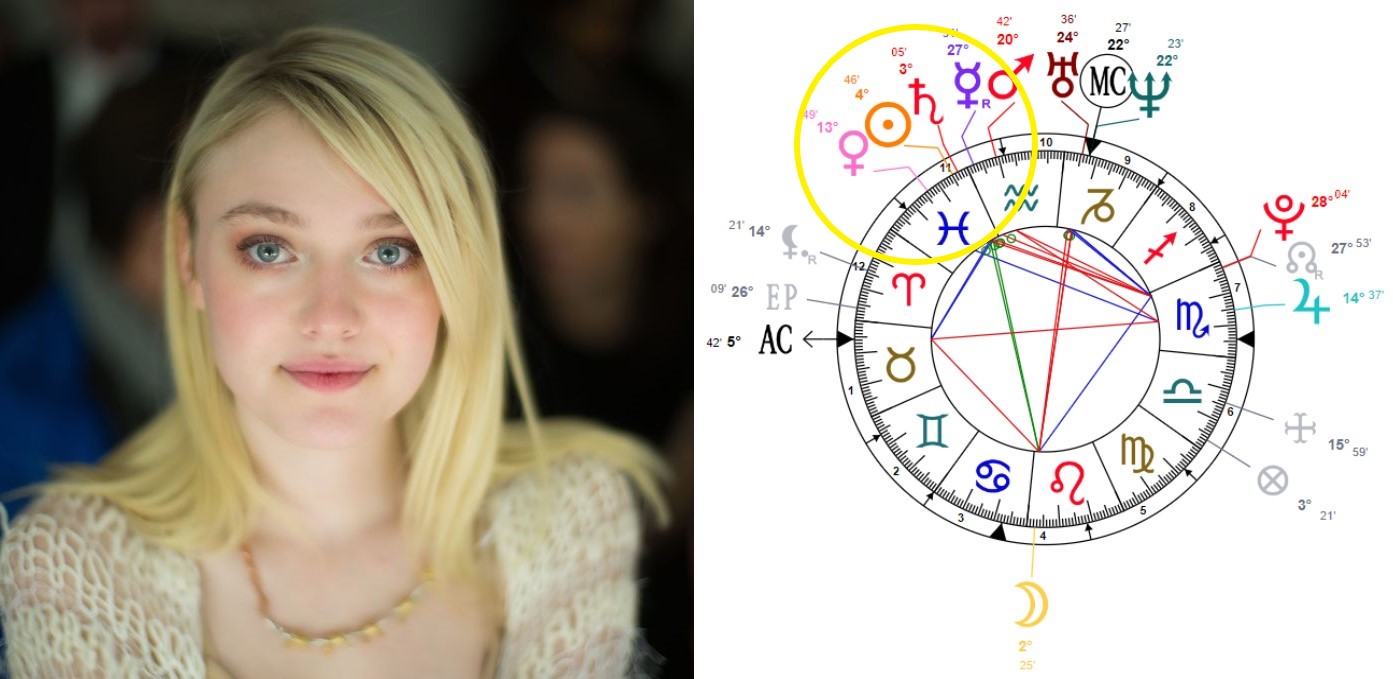
I think that for Dakota, this expression is given by her acting; her profession allows her to express emotions she otherwise would’ve have been deprived from experiencing and understanding. It is by putting in the effort to build her characters’ emotional world, that Dakota gets to feel her own feelings, even if in the process she may not feel as if these emotions are hers anymore.
Although in families there are often similar planetary placements between each family member’s natal chart, usually indicating affinities and karmic binds, it is rare that siblings share such perfect conjunctions. Elle, the younger sister, is a Sun in Aries conjunct Mars, Mercury and Saturn. Her Sun-Saturn link is less tight than Dakota’s as her Sun is placed at 19 degrees and her Saturn is at 22 degrees. Moreover, her Saturn is in detriment while her Sun is exalted in the exuberant sign of Aries. About this strange occurrence of Saturn obscuring the exalted placement of a Sun in Aries, Liz Green writes: “The Sun is exalted in the sign of Saturn’s fall, for the conscious personality is strengthened by its contact with the larger self (…) These two opponents, who sometimes take the guise of God and the Devil, perpetually circle each other about the ring whether they are in actual aspect on the birth chart or not. They are two faces of the same basic principle, and in the individual’s psychology they are related to the conscious personality and the shadow and unconscious personality.” (p.88)

In Dakota’s case, it’s her Venus that is exalted in the beautiful and soft sign of Pisces! Dakota’s beauty, femininity and worth (Venus) as it is integrated into her personality (the Sun) is karmically tested by harsh Saturn in this lifetime. She must work hard to purify the nastier and more superficial aspects of Venus in order to be able to love and feel loved, to amass wealth and genuinely find a way to enjoy it. Her relationships to women and to beauty in general are long-lasting but trying and often may seem boring and predictable. She also must wait in order to access her financial resources or to find wise ways to invest her hard-earn money; some may say that because she worked as a child, her capacity to live out her girlhood was stunted, as she stepped into the role of the father, the provider by acting so small, which is again another aspect of Saturn aspecting Venus.
As an important sidenote, at the moment at which I am writing this article in January of 2024, Dakota is going through her Saturn return, a time of great pressure, responsibility and tests in someone life, often called ‘the dark night of the soul’. But for Dakota this transit may not be so intense as for others due to the fact that she worked for the majority of her life and seems to have a solid occupational focus. On her IMDB page you can see for example a generous career retrospective for someone who is just 29 years old. But the personal and relational themes of her Venus-Sun-Saturn conjunction are underlined even more in her life at the moment: she may get married by the end of this transit or separate from a long-term boyfriend; she may receive the role of her lifetime or quit acting altogether to become a mother. As Liz Green described, with Saturn’s energy it’s a toss of a coin and you may end up on any given side of fate. This interesting stronghold that Saturn provides around Elle’s exalted Sun in Aries and Dakota’s exalted Venus in Pisces is chill-inducing and fascinating to write about. But what is Saturn doing that is good for the two progenies, because both sisters are talented, beautiful and successful in the film industry, each in their own unique way?
Liz Green goes on to describe the inherent duality of Saturn and how it stands for someone whose destiny veers between complete confidence and utter anxiety all blending into one : “There are many other references to this deliberate duality which is unlike the natural instinctive duality or flexibility of the mutable signs. One is the Roman God Janus, god of gateways, for whom the predominantly Capricornian month of January is named and who was possessed of the remarkable attribute of two heads – so that he could look backwards and forwards, ostensibly, guarding where one has been as well where one is going, but also because he was, figuratively as well as literality, two faced” (p.13) In this original description, we see how Saturn seems to offer someone the gift of acting. This is because being able to switch between experiences, emotions and behaviors with skill and precision is the job description of any good actor or actress.
And here is my point: Saturn conjunct the Sun of both Dakota and Elle makes them natural actresses! Saturn also strengthens and purifies everything it touches, as much as it can weigh heavily on someone’s psyche and bring about depression and self-doubt. And we can see the almost angelic-like energy that these two actresses represent, given also by their privileged role in American society as White, middle-class and educated women. But as a public, we may not be aware of the personal setbacks and hardships these girls experienced in order to reach the career heights they are currently on. One thing is for sure, they had disciplined childhoods which may have prevented their opportunities to discover who they really are and what they want to live for.
In the author’s book, the placement of Saturn in a Fire sign is explained in the following way: “Saturn in the fiery signs or houses tends to suggest a barrier between the conscious personality and the intuitive perception of the self as it ordinarily is experienced by fire. This often precipitates a loss of the sense of one’s innate purpose and significance in the broader context of life. Saturn in fire may appear to produce problems which are more philosophical than real in nature (…) Saturn’s effects in the fiery signs and houses may aptly be described as ‘spiritual constipation’ which is observable in ordinary life as a lack of spontaneity and self-expression, lack of vitality and inner confidence, and a feeling of purposelessness” (p.87, 89)
With a Saturn in Aries, Elle Fanning’s karmic inheritance is a duty to understand and develop her will and sense of purposeful activity without veering into megalomania and working only with the purpose to crush her competition. While with a Saturn in Pisces, Dakota Fanning’s karmic bearing is to become aware of the unconscious emotional frustrations which lie behind her actions; unlike her sister, she cannot achieve this alone, since Saturn in a Water sign requires another person’s objective viewpoint to help guide the native through the maze of her own feeling nature (this guide may be a parent, a lover, a hired professional or in her job, a director or a script-writer). Another interesting thing is that immediately upon the completion of Dakota’s Saturn return, Elle will begin hers in 2025! I hope that this tough, astrological maturation experience for both of them will strengthen their sisterhood rather than set them apart. In some cases, separations between siblings are psychologically necessary, especially when the siblings grew up feeling close to each other, but it is always emotionally difficult to lose a sibling, even if just on an emotional level.
In this article, I have mostly written about Saturn, the greater malefic, because I found these examples to be so compelling and also because I am currently reading Liz Greene’s book. I will have to create a part 2 of this article in which I focus on the lesser malefic, Mars. The delay is because I have just ordered “The Mars Book” by Donna van Toen, one of the few resources on this topic which I am eagerly awaiting to read. Hopefully, I may stumble upon a couple of compelling examples of how Mars may work in a benefic way in someone’s chart and thereby correcting the stigma against these two resilience-building planets. Therefore, if you enjoy my articles then I recommend you follow my website to be notified when that article comes out. In the meantime, if you feel inspired to order a birth-chart reading in order to figure out what Mars and Saturn are doing in your own natal chart, then I would be happy to help you with a personal analysis here.
With cosmic love,
Lexi
 The Spiritual Social
Leave a Reply