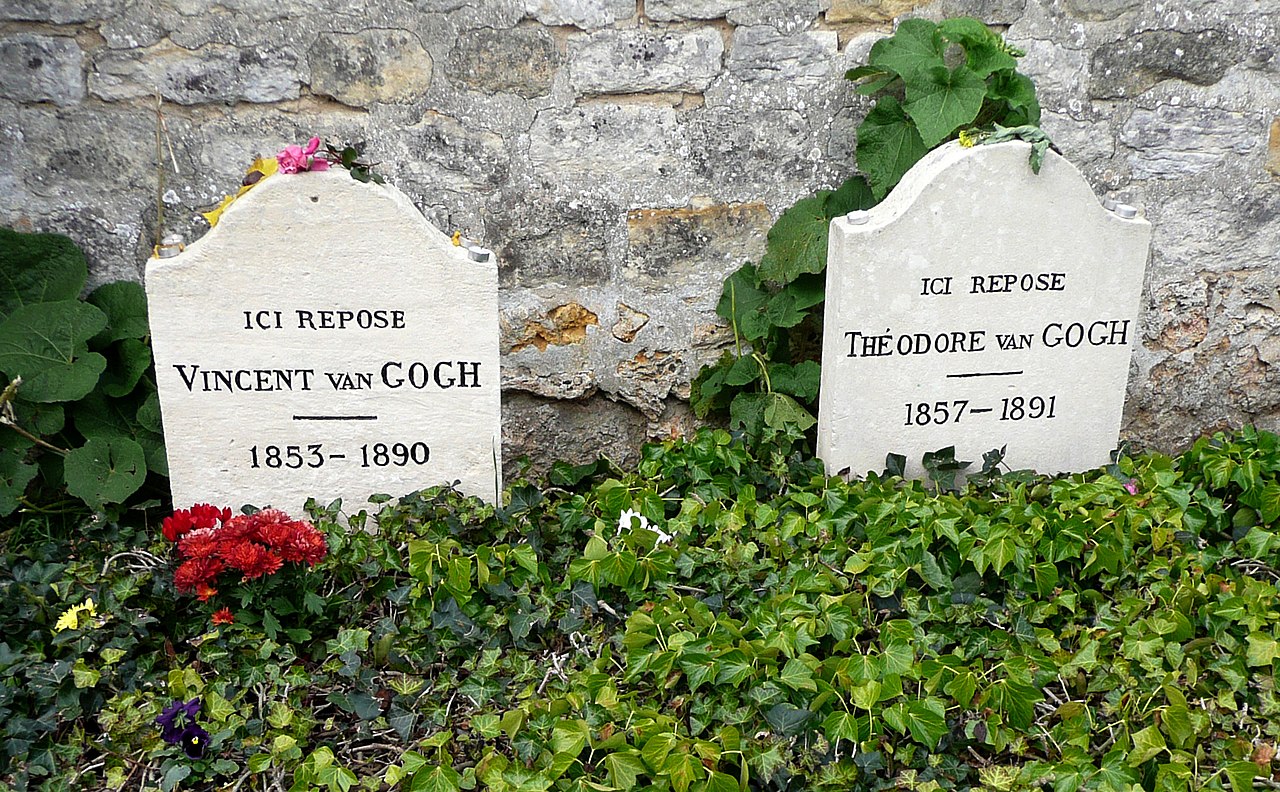
During ‘spooky season’ nothing is spookier and more touching than seeing two famous siblings sharing space in the cemetery at Auvers-sur-Oise in France: https://www.atlasobscura.com/places/grave-of-vincent-and-theo-van-gogh
I recently introduced a new service in my eShop, called ‘The Synastry Report’ which is the analysis of a diagram combining two charts that explore the compatibility between two people. It is mostly used for romantic pairings, but it can also benefit siblings or other kin relationships, and to demonstrate that I thought I would look into the compatible elements between a couple of famous siblings. It is a slightly chilly October day adorned with grayish clouds, so I thought that exploring the chart of the melancholic expressionist painter Vincent Van Gogh and his brother, would fit well with the scenery.
The idea to look into the synastry of the Van Gogh brothers was given to me by a well-known Romanian astrologer, Teodora Muth who gave a rich and terrific presentation on this topic at the 2023 Conference of The Association of Romanian Astrologers, which took place about a week ago. If most of us are aware of the supportive relationship between Vincent Van Gogh, the world-famous Dutch expressionist painter and Theo van Gogh, an art dealer and his younger brother, what was particularly fascinating was finding out just how into self-destruction Vincent was, as he maintained throughout his tumultuous life a number of intoxicating habits that affected not only his social life but also his capacity to see and paint.
When we witness the unearthly beauty of ‘Starry Night over the Rhone’ (completed in the master number year of 1888), we don’t normally think that those shimmering globes in the sky where influenced by the painter’s declining eye-sight and hallucinatory spells, which were mainly caused by a combination of gonoreea, glaucoma, lead poisoning (he used to eat some of his paint tubes), absinthe addiction, and living in a perpetual state of malnourishment. We think that they may be part of an original process of thinking and a specific way of seeing the world. While this may be true, it is significant that after he completed this painting, shortly after followed the infamous ear cutting event between him and Paul Gauguin, which pushed Vincent into entering the mental asylum at Saint-Remy. Remarkably, while he was in the asylum, Vincent unleashed his creativity to such an extent that it is considered he painted 800 out of the 900 paintings in his lifetime, while he stayed there.
We see here the combined influences of asylum, poor health, art, addiction and one important element of Vincent’s life which he often defined himself by, his spirituality and need for the Divine. It all feels familiar & highly Neptunian to me, as I was born under the Neptune-ruled sign of the zodiac (Pisces), and those are by-and-large some of the themes of my own life (well, minus the artistic genius). Keeping all these themes in mind, I wonder now as an astrologer, if there are other indicators in his natal chart that point towards such manifestations of extreme energy? And another question I have, is why did Theo stand by him, when everyone else seemed to have abandoned him? Below is Vincent’s chart and following on after, is his brother’s Theo’s chart, so you may follow along:
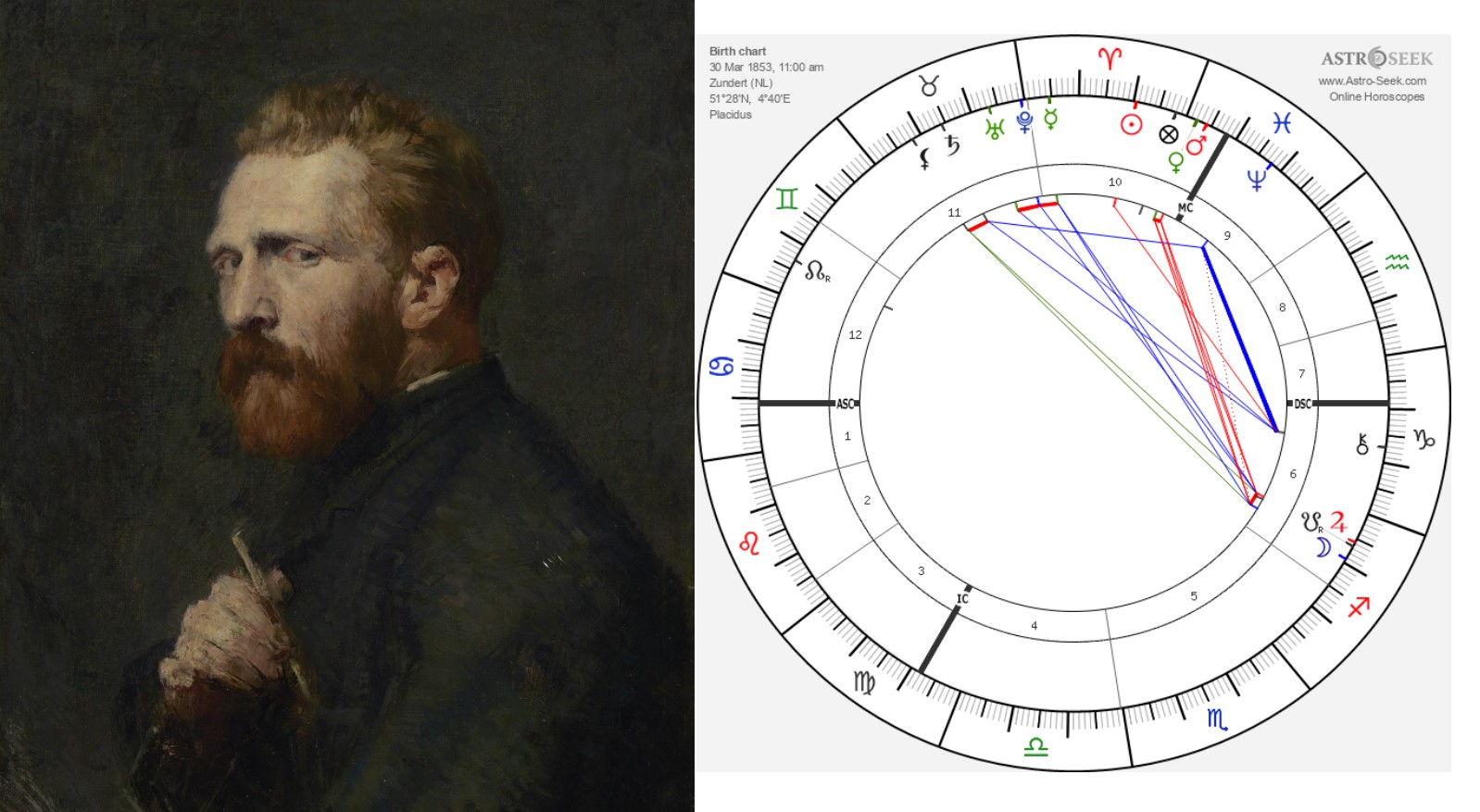
Self-portrait of the artist & birth-chart of Dutch painter, Vincent Van Gogh taken from https://www.astro-seek.com/birth-chart/vincent-van-gogh-horoscope
We notice that Vincent is a Sun in Aries in the 10th house (so he borrows traits from Capricorn energy), he has a Moon in Sagittarius in the 6th house (so with a Virgoan influence) and an Ascendant in Cancer (which makes his Descendant in the sign of Capricorn). His Sun is also conjunct Mercury and the Part of Fortune, while his Moon sits with Jupiter and the South Node (wow!). Immediately, we spot a considerable influence from Fire and Water signs in his chart which are anchored in Earth houses (the 6th and the 10th houses) and while these may be balancing influences, they nonetheless tell the story of a highly sensitive & spiritual soul, simultaneously endowed with ambition and an Ego build around his public achievements. Vincent was a highly creative person who preferred to work alone and had a tendency to emotionally exagerate and sweat over the small things in life, the daily details of his life (Moon in the 6th).
This is the chart of a man emotionally attached to his work and to his daily routine, although he is also struggling to do his best to transcend the boundaries of his daily life & pursue personal, creative freedom (Sagittarius 6th house). Vincent was a wild man at heart, a ‘savage in the city’ as some astrologers describe someone who is born with a Sagittarian South Node, but he craved to form a deep connection to the Divine which would anchor him into a relationship; he also needed to travel and to move around in order to receive his inspiration and find a deeper purpose to life (North Node in Gemini in the 12th house) and I guess he couldn’t figure out how to reconcile freedom with belonging. When he failed to anchor himself into a romantic relationship (he was rejected by the woman he first proposed to), he did so in the one provided by his nearest and dearest: his brother.
As a Gemini North Node in the house of Neptune (the 12th house), Vincent was destined to lead a life that would gradually unravel at the seams and help him loosen up his karmic legacy (which was defined by tradition, morals and control). He was meant to walk the path of an ordinary man in his life, and this is why he was shunned and never got any success, awards or achievements. This is because his comfort zone was packed with the lucky man’s energy, the winner’s role, but this is kind of energy which he needed to grow out of (Jupiter conjunct the South Node). By pursuing the path of a simple, ordinary man (Gemini), focused on taking himself less seriously while developing his artistic skills, he actually ended up becoming extra-ordinary after his death (the ultimate act of ‘letting go’ required by the 12th house, the final sacrifice). He described in his letters that spirituality meant so much to him, and how he needed to be in nature, outdoors and to roam freely, and I see all of these as expressions of his South Node in Sagittarius speaking to his North Node in Gemini. To also mention that Vincent also had a natal stellium in the sturdy and traditional sign of Taurus – which is a very stubborn and ambitious energy that doesn’t like to be rushed – and in the house of friendships and business associates, local groups and his vocation in life (the 11th), I can see the despite preferring to be alone, Vincent needed other people to help him develop his vocation and find meaning in life.
Vincent’s stellium involves the planets Saturn, Uranus and Pluto and the asteroid Lilith also known as Dark Moon Lilith. With the malefic energies of Saturn, Pluto and Lilith and the surprising touch of Uranus here, he had to weather a lot of nasty surprises and power plays from his co-workers, friends and members of his generation (to which I’m certain he felt he didn’t belong to). The famous ear incident involving the artist Gauguin, whom he admired (and some speculate that Vincent was also in love with) can be categorized as part of this karmic energy of having Saturn in the 11th house, the classic indicator of a man clashing with the generation he was born into and of having disputes and bad luck brought to him by his friends and work associates. This aspect in combination with his Chiron in the sign of Capricorn in the 6th house, is related to a deep wound inside of Vincent’s soul about his incapacity to provide, to earn enough money to prove everyone wrong, a wound about not being seen and admired for his true worth at work and among his colleagues (and even in love, since he ended up paying for his pleasures).
The addictions that have plagued his life are symbolic of Vincent’s attempt to soothe his wounded Ego with sex, narcotics and alcohol, things that would make him ‘travel away’ from his daily duties and escape somewhere else, maybe to a place where people would value him, where God loved him and he felt whole. Now, the more I look at this chart the more I feel that it may have been difficult to have him around as a child, friend or lover since he seems to have indicators that show a person with a bottomless need to be loved, one who would take the small gestures made by those around him and blown them up to apoteotic extremes of mental nitpicking and self-induced pain. So I wonder how much of the rejection he felt in life, really came from other people or from his mind, which gradually played more and more tricks on him, as he dived deeper into self-abuse?
He grew from a person born within a large family and with a traditional and orderly life, to the image of an artistic martyr. We tend to assume he simply fell into this role because his art was so unique and not fitting in with the norms of beauty of that time, but I am thinking now, exactly how much of this image that he had crafted, was left to impulse and how much was the result of a deeper understanding of what it actually took to get people to notice his work and see his value? There is an element of calculated self-making that I can observe from Vincent’s chart, especially as with so many rational influences in his 6th and 10th houses and that clever North Node in Gemini, he may have just weighted his odds and decided that ‘if I die, my art will matter to them’ (that is, the artistic community of his time).
Another concern may have been less ambitious and more family-oriented, as very soon after his death his sisters were able to sell some of his paintings and pay off his medical bills. Imagine the empathy and forethought that was necessary to think ahead and determine that a death could help the family; this is the stuff of 12th house magic, the realm of sacrifice that makes someone seem saintly even as they live out extremes of depravity and self-abuse. So rather than seeing Vincent as a rebel that went against what the art world knew at the time, this is the chart of a man who was deeply sensitive to what others had to say about him, even if he lived his life in a way in which it seemed that he had no shame. The chart also shows someone with a rather intense degree of ambition which was only bypassed (or self-sabotaged) by the intensity of his emotions. Those Jupiterian, larger-than-life emotions served him so well in his art but unfortunately not in his daily life.
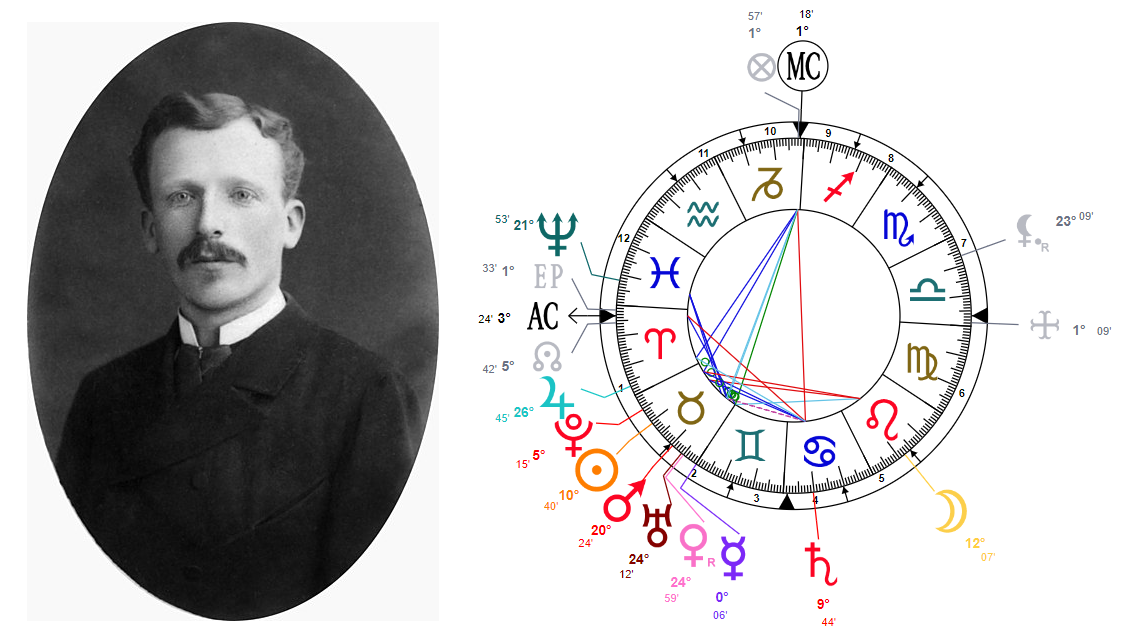
Photo of Dutch art trader and brother of Vincent, Theo Van Gogh taken from https://www.astrotheme.com/astrology/Theo_van_Gogh_(art_dealer) – not to be mistaken with the British artist by the same name, born in 1957
In contrast, we see that Theo, his younger brother has a Sun in Taurus in the 2nd house (conjunct a stellium of luminaries involving Venus, Uranus, Mars and Pluto), a Moon in Leo in the 5th house, and an Aries Ascendant conjunct Jupiter and his North Node (wow!) – talk about sibling twin flames! With his natal Saturn in Cancer in the 4th house and conjunct Vincent’s Ascendant, I feel that Theo found the experience of growing up in their childhood house-hold to be stern, restrictive and emotionally cold. As Vincent has his own natal Saturn in Taurus conjunct Theo’s natal Sun (and an entire stellium), there is a degree of unspoken karmic responsibility between them. Saturn bound them both into a long-term commitment. Despite being the younger brother, Theo ended up playing a caretaker role in Vincent’s life, because he felt some degree of karmic responsibility towards Vincent, but also because Vincent saw him as a man who had his life in order, as someone who managed what he couldn’t: get married and form a family. Even if Theo was the youngest, their dynamic was reversed, as I see that often it was left to Theo to set the boundaries in Vincent’s life.
At the same time, being around Vincent gave Theo the courage to be himself (Jupiter in Aries conjunct Vincent’s Sun) and allowed him to learn how to lead (North Node in Aries). In all honesty, Theo couldn’t quit him, because his soul craved to be like him, in rather obsessive way (North Node in Aries conjunct Vincent’s Sun). I also feel that Theo wished that he had had Vincent’s talent and artistic and bohemian lifestyle, while Vincent valued most of all the support of just having his brother around, of having someone who would tolerate his emotional chaos and narcotic dependencies and just accept him for the wild, free spirit he was.
To be honest, I don’t know much about Theo’s personal life except that he got married and had a son – named after Vincent (which was apparently a move that upset the painter because it unconsciously touched upon a deep family trauma of naming a previously unborn child also Vincent, and thereby locking ‘Vincent the adult’ into a life-time haunting of his dead brother’s ghost) – he was the one holding Vincent when he died, and soon after his death he had an active involvement is preserving his art-work. Moreover, just one year away from Vincent’s death, Theo would also pass away. This is remarkable, as it feels like Vincent and Theo, two brothers born 3 years apart, and who had died one year away from one another, were meant to walk their lives together, like the twins represented by Vincent’s North Node in Gemini. They had complementary professions (art dealer and artist), and complementary lifestyles (married man and bachelor). Who knows what else they would’ve achieved together, if Vincent wouldn’t have decided to leave so early.
Now, after writing the above I cannot help but wonder what kind of synastry did Vincent have with his sisters, the portraits of whom you can see below. It is becoming apparent that the two Van Gogh brothers were close to and kept in touch with their sisters, and that at least one of the sisters’ had an ongoing mental health issue which ended up taking her life. So part of the deeply Neptunian themes of Vincent’s life were not necessarily self-made, as much as they would’ve been inherited both genetically and psychologically, both consciously and unconsciously from the content of his family dynamics. Going so far back in time as the 19th century poses issues related to the accuracy of the birth-date and the time of the birth itself, so please take the above analysis with a grain of salt. It is nonetheless a fascinating life story and family tale that lingers on, long after it ended.
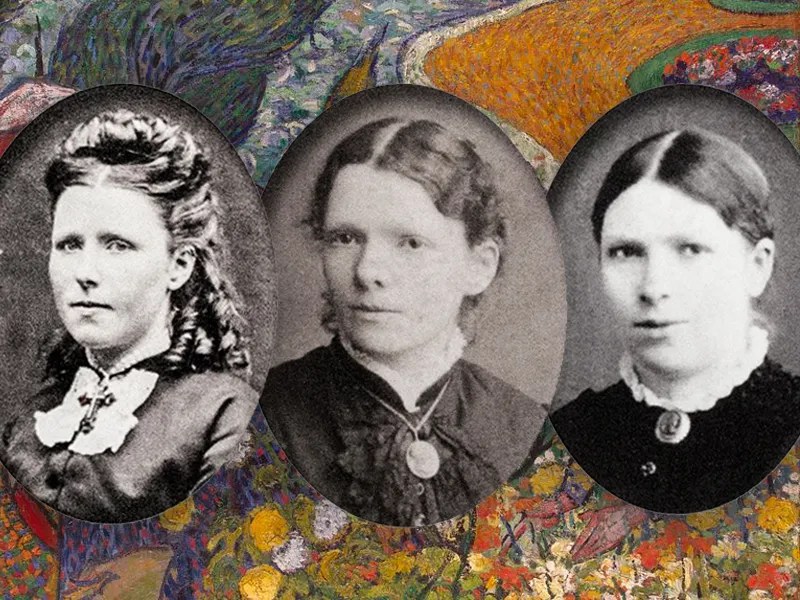
Image of Vincent and Theo’s sisters, taken from the Smithsonian Magazine : https://www.smithsonianmag.com/smart-news/exploring-lives-van-goghs-sisters-through-their-letters-180977325/
If you enjoyed this analysis and would like to get in touch with me for a sibling synastry report, feel free to click on the My e-Shop tab in the menu bar of this website. And please follow this blog to receive notifications when I publish astrological analyses; it’s for free and I’ve got plenty of cases coming up for your astrological enchantment.
With cosmic love,
Lexi
 The Spiritual Social
Leave a Reply