Tag: psychotherapy

  • Shows about Shrinks

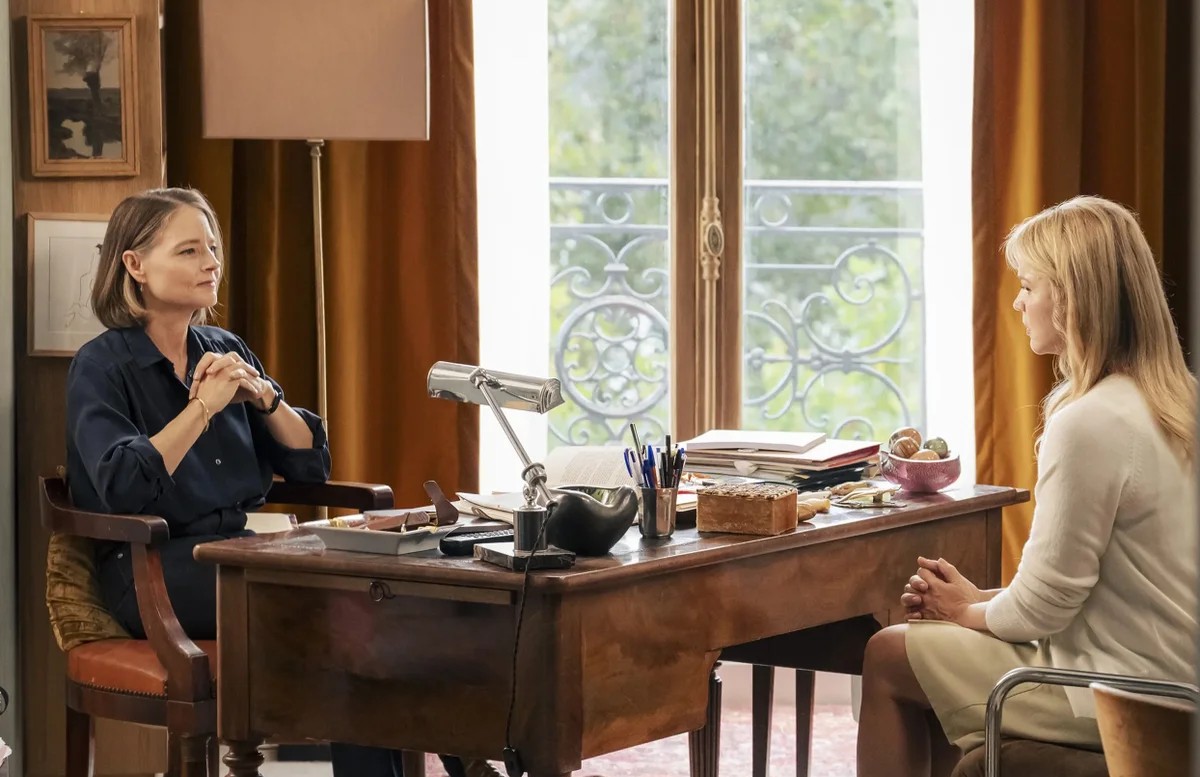
    Jodies Foster as psychotherapist Lilian Steiner in Vie Privee (A Private Life) 2025 : https://www.imdb.com/title/tt33852162/

    “Ours is a psychological age rather than an institutional one” – R. Moore & D. Gillette

    Last week, I had a semi-funny chat with my analyst about the desk and the carpet in her office. As I’m preparing to embody the role of a therapist (hopefully in the coming year), we talk in our sessions not only about my childhood and personal traumas but also about random aspects related to the daily responsibility of showing up to work as a good-enough therapist, a ‘healer of souls’ who has to hold the patient’s emotions and do so within acceptable boundaries.

    I see each day how much of what lives in the mind and inside of our selves has nothing to do with how others perceive us. I tell my analyst my impressions about how I felt intimidated by her large dark-wood desk or that once her carpet was removed from the office I felt like the rug was pulled from underneath my feet. She just laughs and says “My previous client said that he started to hear an echo in the room. But I just sent the carpet to dry cleaning and I do this every year with my rugs. I like to rotate them in my office”. One thing is the fabric of reality and another thing the many, creative and often self-sabotaging ways in which we can interpret it.

    As I’m simultaneously allowing myself to be both a vulnerable client and an increasingly knowledgeable apprentice, I like exposing myself to a wide array of sources to get familiar with a therapist’s work and the various cases I may encounter. I began reading the “The mummy at the dinning room table”, a collection of short vignettes about the most memorable cases of celebrated therapists in the field. And I also finished Elyn R. Saks’ personal account of a brilliant woman living with schizophrenia in “The Center Cannot Hold: My Journey Through Madness”. And when I want to catch a break I watch some more shows about shrinks, because when I get in the zone, it’s hard for me to stop – I need to see the theme all the way through, and I blame this behavior on the Mercury trine Pluto aspect in my natal chart (which is also to blame for my attraction to the field of psychology).

    I began this year, actually in the first week of January by going to the cinema through a thick layer of snow to watch Jodie Foster perform (in impeccable French!) the role of a therapist who spirals in chaotic ways once one of her clients commits suicide. It’s a very odd and unique movie that kept me hooked, primarily because it’s a movie led by a woman therapist (and sadly, we don’t have many of those around) and it is focused on her forgetting to practice probably the most important thing in her line of work, which is to listen (not just non-judgmentally, but to listen to people overall).

    Caught up in her unresolved personal affairs and emotionally blocked by her client’s shocking demise, she begins to live a little outside of her clinical setting and finds her heart again. The final scene in the movie made me burst into tears as it was so impactful after the zaniness of the whole movie, which combines drama with savage laughter. I also just love Jodie Foster, who like my own analyst at the moment, is a Scorpio Sun.
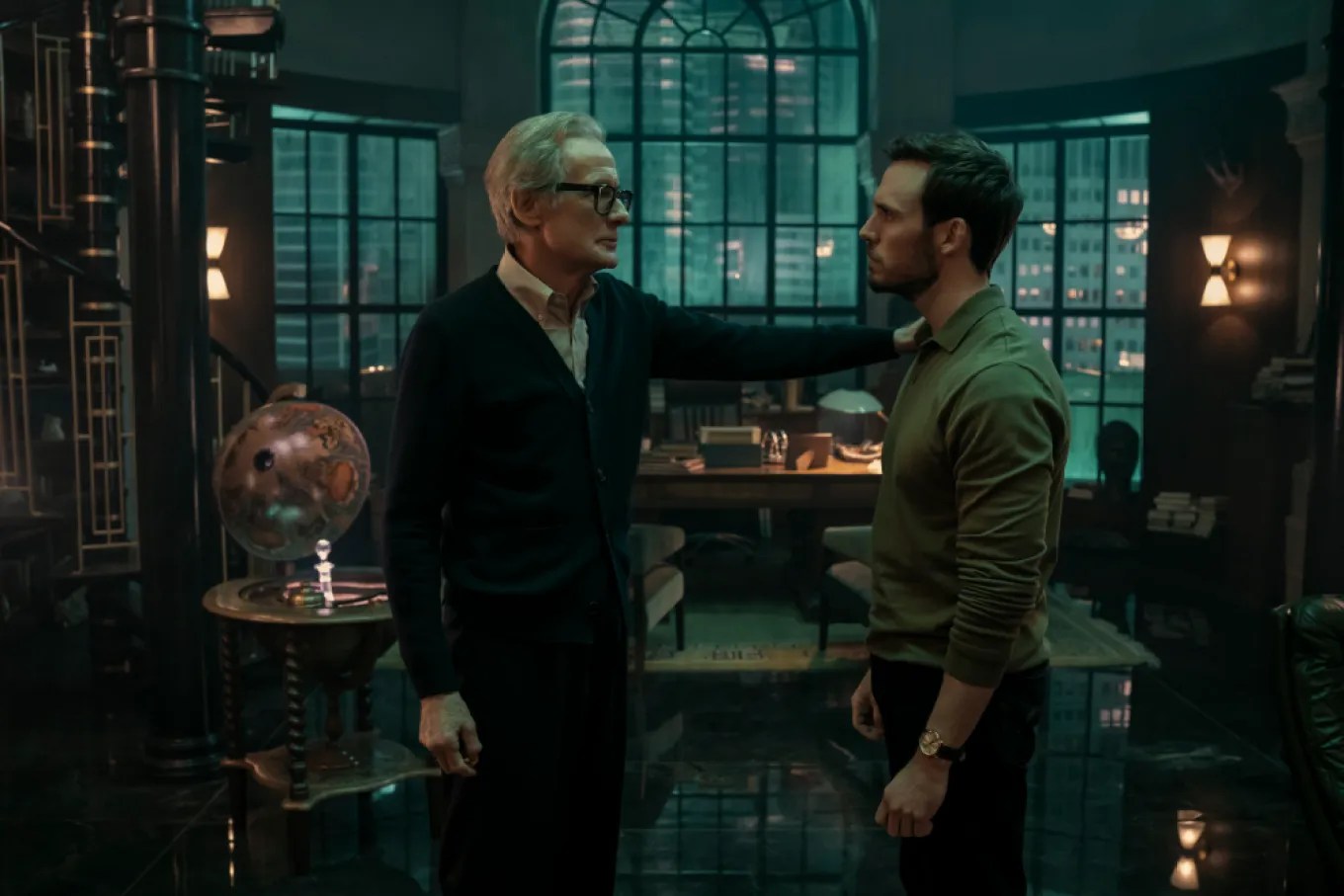
    Sam Claflin as Dr. Joel Lazarus alongside his father played by Bill Nighy in the mini-series Lazarus (2025): https://www.imdb.com/title/tt31186865/

    Moving on to the second show I watched, which was Lazarus, about a distraught psychiatrist who communicates with ghosts and finds out some disturbing things about his own father’s legacy. Although, I have a bit of a crush on Sam and really enjoyed watching him unravel on screen, I was in general slightly put off by this show. It was overly dramatic in the directorial style and the “too cool for school” editing, so that really made me wince a couple of times. What kept me watching was Sam Claflin, who is easy on the eye and damn good at switching between emotions. Of course, I wouldn’t expect anything else from a Sun in Cancer with a Pisces Moon, so yes, I was happy to tune in each night and see a talented actor go over many professional boundaries in this desperate pursuit to understand why his patients are dying and why his father keeps haunting him.

    Just for the record, I don’t know if I should write this or not, because it seems pretty obvious, but what therapists perform in movies has little to do with how therapy actually takes place in reality. Obviously, you do have a similar setting, usually a face-to-face conversation between someone who listens and offers advice and someone else who struggles and seeks help, but aside from that the similarities between on-screen therapy and real-life therapy end. It’s also good to keep in mind that there are so many different modalities of therapy you can practice or choose from, and one of my favorite games to play when I watch a show with shrinks is to figure out: a) “What modality is the therapist trained in?” and b) “Will this show confound psychiatry with psychotherapy again?” Believe it or not, they are different things.

    A psychiatrist is more of a medical doctor who can prescribe medications and is usually having relatively surface-level conversations with you, about your medication intake, behaviors, diet and overall life-style. While a psychotherapist offers exclusively verbal support and cannot prescribe pills to help you regulate your system, but may use fun techniques to help you remember, to help you dream or to help you confront aspects of yourself that may heal you. I’m using ‘may’ because therapeutic work can be as frustrating in its lack of outcomes as any other profession, and the first things you are learning as a student of psychotherapy is that you should prepare to fail, to lose clients and to not know it all. Being humble helps a lot in this profession, in which power issues can be disproportionate and problematic.

    I also really enjoyed the art deco, gloomy set design in Lazarus, displayed by the lavish psychiatrist office of Lazarus’ father, which to be honest, who can afford these days, especially on an NHS budget, but let’s roll with movie-logics and pretend that the gorgeous vintage office makes sense in today’s economy, although it fits better in a Spider Noir setting. Speaking of which, I wish that there would be more shows with shrinks in black and white or at least sepia undertones, like flicking through the pages of an old, vintage photo album.

    From a personal pov, by watching Sam play Lazarus, I realized as well that I am uncomfortably drawn towards intelligent yet emotionally vulnerable men, to the extent that I had a whole session with my analyst about where this bizarre attraction comes from. So I guess I can thank this show and Sam’s charisma for helping me understand a part of myself that I was weirdly not aware of and may benefit by keeping it in check, as I assume a lot of my future clients would fit this profile.
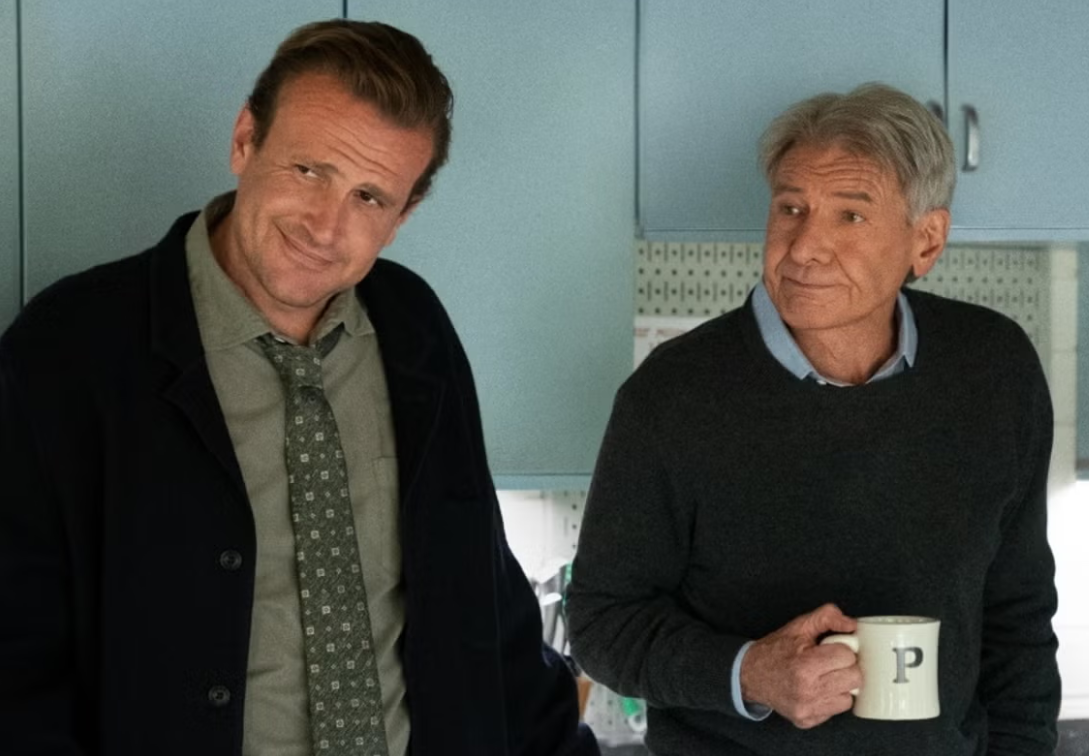
    Jason Segel as Jimmy and Harrison Ford as his colleague, Paul in the series ‘Shrinking’ (2023-): https://www.imdb.com/title/tt15677150/

    And speaking of not being aware of a lot of patterns and blatantly crossing professional boundaries in your psychotherapeutic work, I watched the first two seasons of “Shrinking” and I have to admit I’m not sure whether I like this show or not. It’s irreverent in its depiction of cognitive behavioral therapists and their messy personal lives and you get that the show is trying to humanize them and to break through the intimidatingly impenetrable facade that most therapists have spent years creating (or hiding behind). And I like that, but in other parts the show can be kind of rude and insensitive.

    Much like Lazarus, it just feels dramatic for the sake of provoking outrageous emotional reactions from its public. For example, I really don’t know if it was necessary to have Harrison Ford (a Cancer Sun) drive a fast sports car in the show’s pilot episode just to prove his virility and lust for life in spite of being diagnosed with Parkinson’s moments before. I mean, it’s ok to be vulnerable, weak and old, America. Some scenes felt too on the nose and this bothered me about this show.

    The most controversial character in the series is Jimmy played by Jason Segel (a Capricorn Sun), who even has a whole episode dedicated to his unusual habit of “Jimmying” or going far too deep into his patients’ lives and adopting some shock-therapy practices to help them in their healing process (as a sidenote, one of his clients, a veteran with anger-issues, lives in his pool house! which is a gross ethical violation of the client-therapist alliance). On top of this, the screenwriters struggle so much to make Jimmy seem like a flawed man, a dad who is struggling as a single parent and a therapist looking for his father’s unconscious approval (as we see in his relationship to Paul), that he ends up becoming a sketch of a person, almost a poster man for the image of the ‘modern-day quirky and messed up White therapist with a good heart’. Just for the record, it’s not advisable nor commendable to act in such a way as a professional and actually most therapists put in years of hard work and analysis in order to tame the impulses that Jimmy so generously lavishes in.

    In conclusion, as an apprentice Jungian analyst I watched three shows with “shrinks” and without a doubt, A Private Life was my favorite, the other two being “meah” and rather funny experiments into depicting what psychiatrists and psychotherapists actually do.

    With cosmic compassion,

    Lexi
  • Kindred Spirits

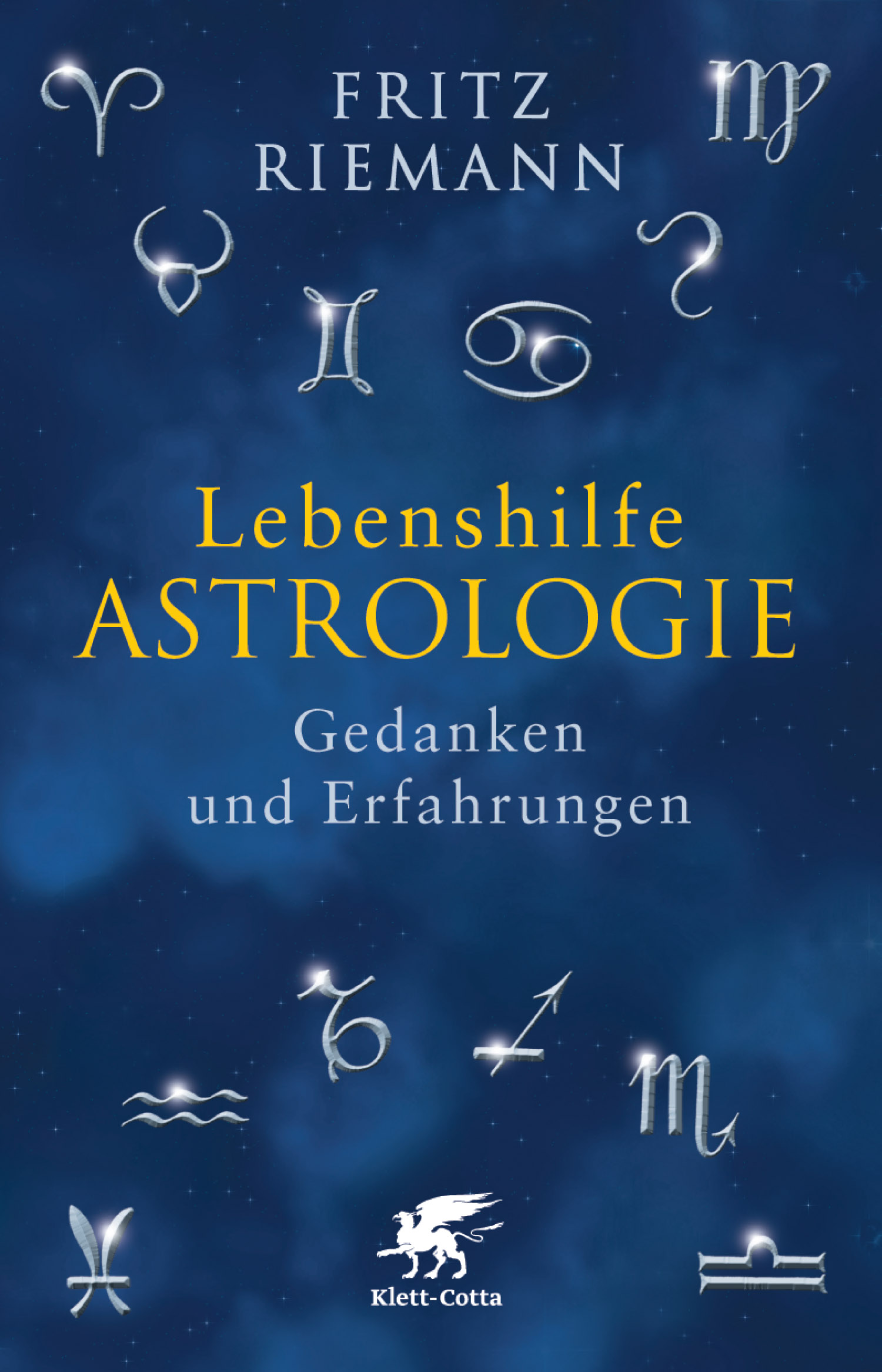
    I think I have found my spiritual father. His name is Fritz Riemann and I’ve been reading his work in the past week, at my analyst’s recommendation. I began first with his book which in English has been rather poorly translated as “Anxiety: Using Depth Psychology to Find a Balance in Your Life” (in its original: “Grundformen der Angst“), and then I realised that he was also the author of another book I had on my list, the beautifully titled “Astrology and Psychotherapy” (or “Lebenshilfe Astrologie“) a book which I see as the manual to my future profession.

    German cover to Fritz Riemann’s book “Astrology and Psychotherapy”, which you can access here: https://www.klett-cotta.de/produkt/fritz-riemann-lebenshilfe-astrologie-9783608946574-t-4101

    I’m just two weeks away from turning 39 years old, an age which is usually marked by something called the mid-life crisis. This is described as a pivotal period in a person’s life (usually spanning from the 37th year of life until the 41st) in which the foundations in a person’s life are revised and new decisions for the future have to be made. It’s like a pitstop in the middle of a person’s life in which past actions are coming up for scrutiny in order to find the answer to the burning question “How do I move forward in life?”.

    It’s called a “crisis” because something breaks down (usually a career path or a significant relationship, a way of life) and this catapults the individual into a pressure chamber of a mindspace, in which solutions need to be found with urgency.

    Carl Jung wrote about this period in a positive light. He saw this breakdown as a special indication that a person was getting closer to living out the truth of their identity or in his terms, the crisis was an opportunity to finally ‘individuate’. What made the crisis so intense was the extent to which someone had lied to themselves so far in their lives, and build a life on shaky and borrowed values, rather than on their personal intuition or on what mattered most to their individuality. In his words:

    The nearer we approach to the middle of life, and the better we have succeeded in entrenching ourselves in our personal attitudes and social positions, the more it appears as if we had discovered the right course and the right ideals and principles of behaviour. For this reason, we suppose them to be eternally valid, and make a virtue of unchangeably clinging to them. We overlook the essential fact that the social goal is attained only at the cost of a diminution of personality. Many—far too many aspects of life which should also have been experienced lie in the lumber-room among dusty memories; but sometimes, too, they are glowing coals under grey ashes. – C. Jung, The Collected Works, p. 395

    Astrologers also wrote about this period as being one marked by the multiple aspects that transiting Saturn would be making to the natal Saturn and Uranus placements in an individual’s chart, precipitating painful and unexpected changes that have long-lasting consequences. The most notable of which is Erin Sullivan in her book “The Astrology of Midlife and Aging”. Sullivan describes the mid-life crisis as:

    “Between the ages of thirty-seven and forty-one, in synchrony with the transit of the planet Uranus’ opposition to its place in the horoscope, something mysterious takes place within the psyche. Further, Dante says: “I cannot clearly say how I had entered the wood; I was so full of sleep just at the point where I abandoned the true path” (II 10-13) The ‘sleep’ with which we are full at the meeting at the crossroads is really the unconscious life that we have within and that is still unlived. Jung said that in this phase of life one is living the “unlived life”, assuming correctly that midlife does not begin a time of rapid decay, loss of libido, and inevitable death but rather in a time in which one might recollect one’s life and, from that recollection, build upon a profound understanding and conscious action toward the next phase of adulthood.” Sullivan, The Astrology of Midlife and Aging, p. 4

    Similarly to what Jung and Sullivan have described in their books, I also find myself needing to change my profession at this turning point in my life, as I am no longer able to make a living out of just being an astrologer and tarot reader. I am lucky that I am able to have the interior and exterior resources to be able to undergo this transition with a relative amount of meaning. After I was hit with the transit of Saturn conjunct my natal Mercury and Sun in the last 3 years, I witnessed the gradual loss of a lot of the things and people which used to anchor me in place. I’ve also felt blocked in my development, both creatively and emotionally and frustrated with life.

    This produced a crisis of meaning inside of myself and aware that Saturn rules over time and old age, I sought the wisdom of those older than me. In a random way – and possibly influenced by this year’s transit of nostalgic Jupiter in Cancer – I was reminded of an old dream of mine, that of completing my psychotherapeutic training. So after my father’s death I signed up for a professional training to become a Jungian analyst. And I’m happy to say that as lost as I was a couple of years ago, I am now meaningfully placed exactly where I need to be, since my current training offers me a sense of purpose and meaning, which I was robbed off in the past.

    However, there are still plenty of difficulties to overcome, most of which have to do with the reshaping of my very soul. I am overwhelmed at the moment by moods, fears and bouts of low energy, which I am processing each week with the help of my supervising analyst, by doing dream analysis and art therapy. This is where depth psychology and the work of many Jungian analysts come in handy, as I don’t believe I would’ve been able to start the process of “mining” through my memories and rearranging my inside, without their help.

    So here I am, in my second semester of professional training reading the works of Fritz Riemann and Marion Woodman, my substitute spiritual mother and father. While the German author is helping me stitch together my previous experience as an astrologer and put it in relation to my current experience of being a trainee psychotherapist, Marion Woodman is my wise maternal guide, helping me understand the deeper layers of my psyche and especially my relation to my own Shadow, and what lies beneath it: the Animus and the Death Mother Archetype, two figures who have been haunting me for a while.

    After, watching the documentary “The Way of the Dream” and having read her interview with Daniella Sieff titled “Confronting the Death Mother: An Interview with Marion Woodman“, I was curious to find out more about Marion, much like I wanted to discover more about Fritz and his attraction to astrology. I kind of feel like they are kindred spirits to me, or at least ancient members of my soul family. So naturally I pulled up their birth-charts.

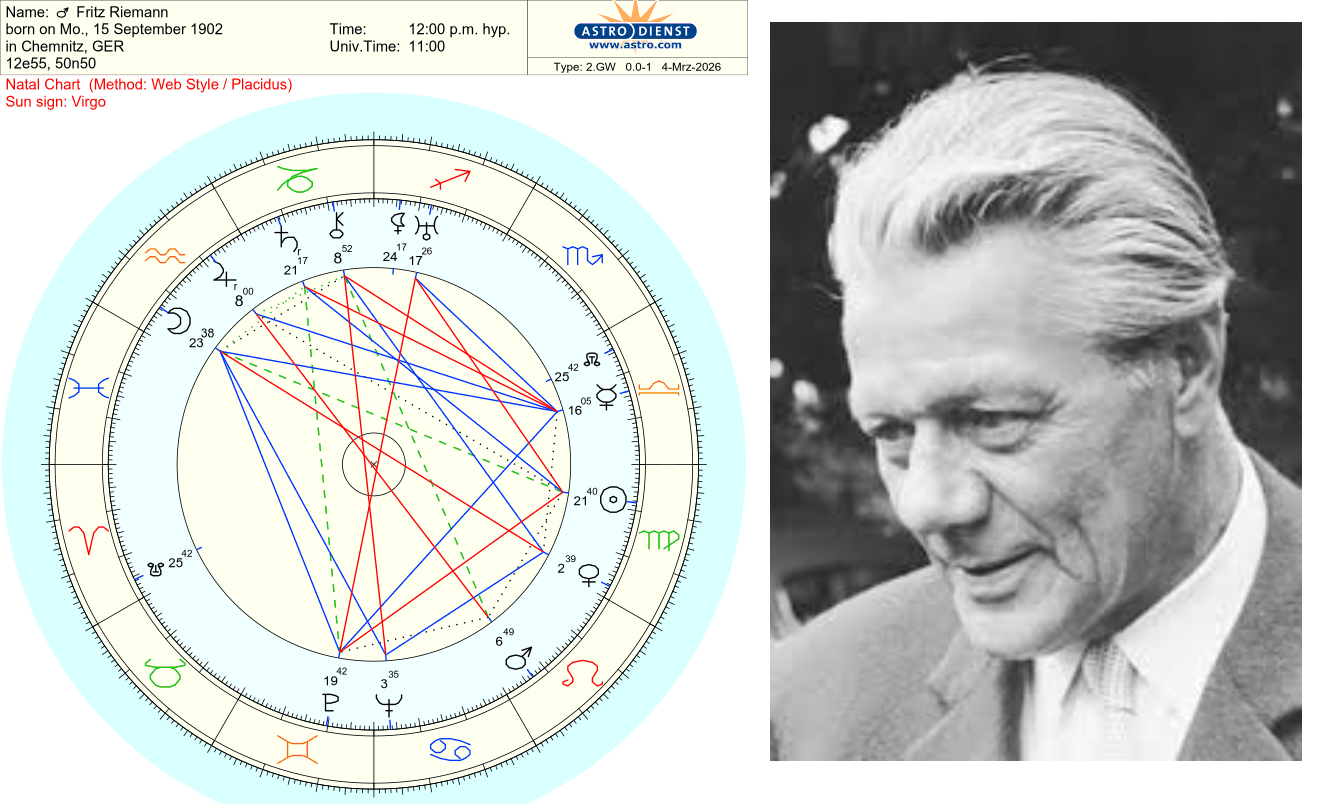
    Birth-chart of German author and psychotherapist, Fritz Riemann. Created with https://www.astro.com/index_e.htm

    Fritz was born a Sun in Virgo (loosely conjunct Venus), with a Moon in Aquarius (loosely conjunct Jupiter). He has a natal Saturn in Capricorn conjunct Chiron (the Wounded Healer Archetype) and a Uranus in Sagittarius conjunct Lilith (the Wild Feminine Archetype). Remarkably he is a member of the Pluto in Gemini generation and he has a natal Neptune in fellow water sign, Cancer. His Mars is in proud Leo and his Mercury is conjunct his North Node, both in the sign of Libra.

    His comfort zone, is marked by Aries, as his South Node is in Aries. Unfortunately, I have no idea in which astrological houses these planets are falling because I am lacking information on his birth time, and hence there is no Ascendant. But he seemed like a charismatic and optimistic fellow (which is rare for Virgo men to be honest). So I am wondering if perhaps his Ascendant was in Leo, which would’ve placed his Mars conjunct it too?

    In terms of comparing our charts and finding out why I feel he is one of my kindred spirits, I can see that he has his nodal placement opposite to mine as I was born with a SN in Libra/NN in Aries, and that his Moon and Jupiter fall around my Venus in Aquarius (so I fall in love with the ideas that he cared about, and with Aquarius energy these ideas are indeed audacious and astrological).

    Moreover, his Uranus in Sagittarius is conjunct my natal Saturn in the same sign (which makes him the perfect, wacky mentor for me) and his Pluto in Gemini sits in a tight conjunction to my natal Chiron in Gemini in the 8th house, while his Mars in Leo sits on top of my Midheaven. I interpret these two final aspects as being motivating and healing to me, even from beyond his grave. No wonder, I see his work as that of my spiritual father figure.

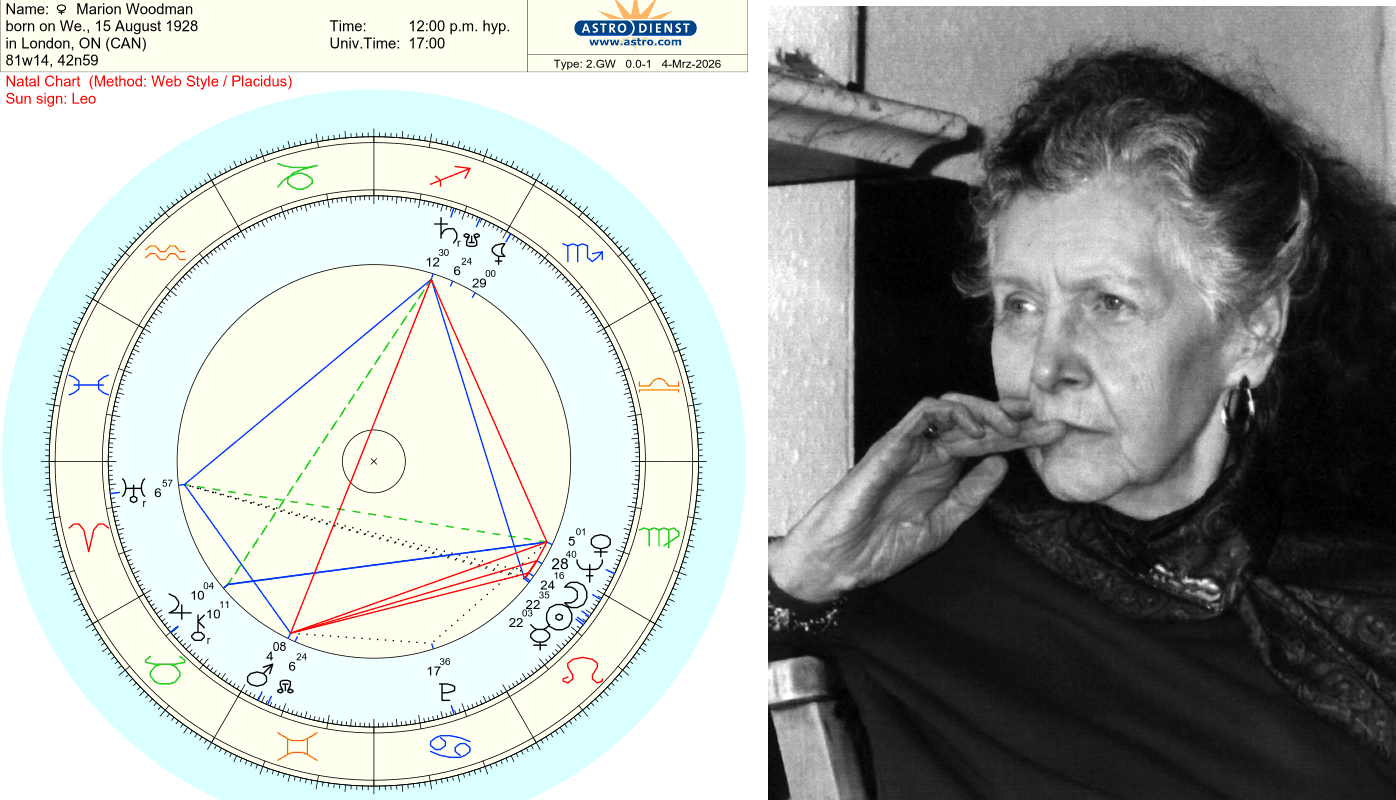
    Birth-chart of Canadian author and analyst, Marion Woodman. Created with https://www.astro.com/index_e.htm

    Moving on to Marion, she was born with a Sun in Leo conjunct the Moon and Mercury (so she is a New Moon baby, an aspect that denotes a pioneering spirit and a true individualist). She has her natal Venus conjunct Neptune in Virgo, an aspect which made her perfect for analytical work but it may have gradually eaten down her relationships due to a perfectionist streak. Furthermore, her natal Mars is conjunct the North Node in Gemini and her South Node is in Sagittarius (and sadly) conjunct her Saturn, which denotes a rough upbringing no matter how positive the Jupiterian influence may be.

    In addition, I see a bold Uranus in Aries, Pluto in maternal Cancer and Jupiter in enterprising Taurus conjunct Chiron (the Wounded Healer Archetype). You can easily see that she has not had an easy life and that growth for her came during painful moments when she was wounded but she had to heal others (Jupiter conjunct Chiron). At the same time, she was able to increase her awareness of the pains of the human condition and bring truth in areas of life previously thought of as taboo, such as in her description of the Inner Tyrant. Her book “The Ravaged Bridegroom: Masculinity in Women” is a pearl in terms of helping me understand the painful underbelly of romantic attractions and why they usually fail and end up in heart-break.

    Being born with Saturn conjunct your comfort zone means that any comfort in early life is usually robbed off you as a form of karmic debt, and Marion has been vocal in her book “Leaving my father’s house: A Journey to conscious femininity” about the strained relationship she has had with her father who blocked her chances of being herself (Saturn in Sagittarius). But she was an exceptionally intelligent and wise woman, almost to the point of having an intelligence which stood against her in many ways, and may have self-sabotaged her chances of being happy in life.

    In terms of placing her chart in conversation with my own natal chart, the fist thing I noticed is how we share the same Saturn placement and how her South Node is almost perfectly conjunct my Moon in Sagittarius, denoting a deep and unconsciously fertile link between the wisdom she provides and my compulsive search for wisdom. In addition, her Uranus in Aries is conjunct my natal North Node and Jupiter in Aries, making her a truly wise, maternal guide for me to learn a lot from, especially in relation to my own masculinity and wounded Animus (Aries).

    Moreover, her Pluto in Cancer falls in my 9th house, where I have Lilith in Cancer (the Wild Feminine Archetype), an aspect which I fondly refer to as the Erin Brockovich effect in terms of using feminine power to combat the abuses of the patriarchy. Marion’s writings liberate me and give me the feeling that I can live life completely free of taboos and complexes as a powerful woman, surviving a changing world (much like Marion had lived her life).

    It’s strange how I just begun with an intuition that I should read the works of both Fritz and Marion, and then as I dived into their work and found how strongly it resonated with me, I fell under the suspicion that it may be more to our shared energies than meets the eye. Astrology then showed me in concrete ways, of what I initially just spun out of the thin air of a gut feeling, that I was correct. So I rest my case once more.

    Astrology is truly magical, and following your intuition and insights is almost like putting the whole energy of your natal chart in motion towards fated events. This is why it is so important to allow the inner compass to guide you in life, rather than fall for external opinions or follow the indications of others. Trust your gut, trust you path and walk in the direction of your soul tribe. Pursue interests and learn from those who came before you. I would even go so far as to say that this may be the pragmatic application of Jung’s core theme of individuation.

    May your journey be filled with suprising joy and boundless wisdom!

    With light,

    Lexi