
It’s been a while since I wrote a light-hearted post and seeing as Christmas is just around the corner, I thought I would indulge a deep curiosity of mine and take you on a fun, astrological trip as well: What exactly is Santa’s zodiac sign? And could I track down his birth-date, time and place? And once cast, what planets would I find in this famous, jolly man’s chart? Let’s investigate 🙂 I begin my search at the source, more precisely the website santaclaus.com. If you use the search bar to look for Santa’s birthday you get redirected to a page in which you are being told the fun fact of the day: that Santa’s birthday is the 15th of March. Wow, that was easy – Santa is a Pisces Sun, just like me, whoopie! Ok, but a true investigator looks for more facts before drawing a conclusion. So I do a similar search on the website that is in charge of Santa’s yearly correspondence and the Santaverse, called elfontheshelf.com and am being given the same result. Double match! But this is suspicious, why are we not given any other details about Santa’s birth? Just the fact that this date is thrown around on the websites concerned with Santa’s lore is not enough to convince me that it is the truth of the matter.
So I take a different approach and I run quick searches for Santa Claus on Wikipedia and Britannica in order to dive a bit deeper into the history behind Santa’s life and the circumstances of his birth. Results show me that the name Claus could be the short form of Nicholaus and that celebrating Santa Claus’ arrival on Christmas Eve was an extension of the celebration of Saint Nicholas’ name day, which takes place on the 6th of December, a mere couple of days before the Winter Solstice or Christmas (21st-25th of December). I always thought it was weird how we celebrated as children both Saint Nicholaus and then also Santa Claus at a short distance one from the other, and how they both had links to gift-giving and the moral reprimand of being a good enough child to earn gifts. Armed with flashback of my childhood, I remained intrigued and continued searching.
As I was searching I pondered that the moral and generous qualities of Saint Nicholas would fit well with a Sagittarius Sun birthday, making him ruled by Jupiter, the Great Benefic, an energy of generosity, optimism, growth and excess. But I found this Wikipedia explanation as to why, Saint Nicholas gradually become associated with the image of Santa Claus and attributed the habit of giving gifts to children:
“During the Middle Ages, often on the evening before his name day of 6 December, children were bestowed gifts in his honour. This date was earlier than the original day of gifts for the children, which moved in the course of the Reformation and its opposition to the veneration of saints in many countries on 24 and 25 December. The custom of gifting to children at Christmas was propagated by Martin Luther as an alternative to the previous very popular gift custom on St. Nicholas, to focus the interest of the children to Christ instead of the veneration of saints. Martin Luther first suggested the Christkind as the bringer of gifts. But Nicholas remained popular as gifts bearer for the people.[8][9]“
Interesting. And in this context, I am slightly perplexed as to why Santa Claus is officially described as celebrating his birthday on March 15th? Why not make it 6th of December then? Traditionally it would make some sense as both Sagittarius and Pisces used to share the same planetary ruler before the discovery of Neptune during the Autumnal Equinox of 1846; both zodiac signs were ruled by Jupiter, or Great Jove, but this shared ruler hypothesis isn’t enough to help me make sense of why these two dates are competing for Saint Nicholas’ birthday. I am nosy and somewhat dissatisfied with this facile association, so I click on the Saint Nicholas wikipedia page and I am sent to this promising lead:
Saint Nicholas of Myra[a] (traditionally 15 March 270 – 6 December 343),[3][4][b] also known as Nicholas of Bari, was an early Christian bishop of Greek descent from the maritime city of Patara in Anatolia (in modern-day Antalya Province, Turkey) during the time of the Roman Empire.[7][8]
Amazing! Now I have something to work with. It seems that Nicholas of Myra was a bishop born during the time of the Roman Empire, on the 15th of March in what is now modern-day Kaş in Antalya, a region of Turkey. After a lifetime of service to Christianity, he died at the age of 73 on the 6th of December, a day which became associated with his name, as after his death he entered the Christian canon and became sanctified. But because of the Christian reformation that took place during the Middle Ages, Nicholas’ celebration became associated with Christmas and the act of giving gifts to children. In a nutshell: he was born in March and he died in December, this is why we have these two dates!

Ok, all of these aspects to the side, let’s cast a chart for the date of 15th of March 270 BC for the region of Patara/modern day Kaş in Antalya, Turkey. I first check the coordinates of the ancient city of Patara to the ones generated in the location provided by the birth data entry generator for the town of Kaş, and they are almost perfect aligned. However, I encounter another obstacle in that the calculator follows the Gregorian calendar and seems to stop generating charts before the year of 1582 AD. I could adjust this date by adding the particle ‘jul’ next to the year, so I do exactly that. Seeing how difficult it was to find his birth-day and the exact location of his birth, I’m giving up on the idea of there being a recorded actual time of his birth, so we’ll have to let go of knowing Santa’s Ascendant (for the time being). The final input data I have resembles a magic formula at this point, but it allows me to cast his chart and I get this image below:

Oh my God! A look inside Santa Claus’ chart, which is probably the best Christmas gift ever 🙂 I’ll take a short break from my excitement and let you know that there is another method for checking the planetary positions in the sky for the given date (15th March 270 BC) and that is to track down the ephemeris generated by astro.com for that specific year and look up the month of March of that year. It took me a while to track down such a specific ephemeris but following this link opens up a vault of astrological knowledge from before our Christian era. After searching for the year, the month and the day, I generated this screenshot:
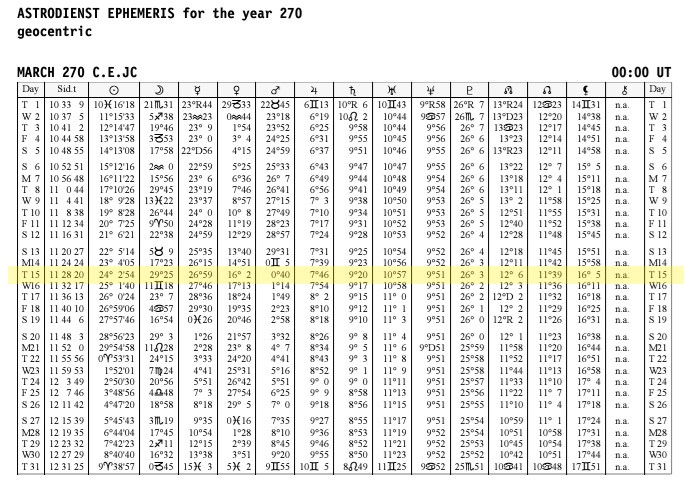
As you can see from the images above, we now have two charts packed with astrological data pertaining to Santa’s birth. Fig. A is the more correct one, as it includes Santa’s birth-place which is not something that was used in the creation of the ephemeris in Fig. B. We can use the second chart just to compare the accuracy of the outer-planetary transits, a couple of his personal planets (excluding the Moon’s position which is strongly tied to the birth-place) and the position of the nodes of the Moon and Lilith as a significant asteroid (data on Chiron is sadly not available). Remarkably we see the same pattern: Santa was born with a Pluto in Scorpio (just like Millennials!), a Uranus in Gemini (a transit which is coming up in 2025), a Saturn in Leo, a Jupiter in Gemini conjunct Lilith (he would’ve experienced his Jupiter return, this year in 2024!) and a North Node in Cancer/South Node in Capricorn conjunct Neptune in Cancer (talk about a destiny of being associated with nurturing children, wow!). Needless to say, my mind is blown…
Let’s take a closer look at the first figure and Santa’s personal placements. So, he was born as an altruistic and spiritual Pisces Sun, with a Moon in Gemini – which would make him a bit of a sceptic and trickster, if his Moon would not be in a conjunction to Jupiter, granting him a generous and faithful heart and access to expansive and loving emotions. Not only that but his lunar energy is also conjunct an unripe Mars in Gemini at the 0 degrees and Uranus, who is operating very well in the friendly and child-like energy of Gemini, thereby ensuring that Santa’s generous optimism is delivered to people, in surprising and unexpected ways. Gemini is also the sign of toys and toy-making, puppets and pulling strings, and we see how Santa literally has the spontaneous gift-giving of toys to little ones tattooed in his chart!
That good and bad dichotomy is also present in his chart, as both Pisces and Gemini are flexible Water and Air signs, who often pendulate between being moral and immoral, kind and mischievous, honourable and treacherous; simply put they can be walking-talking contradictions. The other part of his chart which speaks about his destined connection to children is his Neptune in Cancer (a motherly and family-oriented sign) sitting in conjunction to his North Node in Cancer (a point of growth in life that is connected to feelings, artistry, sensitivity and nurturance). I can see that it wasn’t easy for Santa to walk the path of being generous and loving, since his comfort zone is one of frugality, stoicism, hardship and financial discipline (South Node in Capricorn). Santa could’ve been quite miserly before he became well-known for his generous distribution of gifts across the Globe, and it was told that he was born in a wealthy family of Greek Christians who sadly died during an epidemic. This prompted young Nicholas to give his riches to the poor and conduct others acts of kindness such as helping the three daughters of a devout merchant get married even in the absence of dowries and then resurrecting three children, who had been murdered and pickled in brine by a butcher planning to sell them as pork during a famine. We see how money and death (South Node in Capricorn) are linked to losing his family, helping women and children (North Node in Cancer) and how these themes are intertwined into his legacy and destiny.
I also find it interesting how Santa was years ahead of his peers in his behaviour and altruism for the plight of women and children. He was born with a Venus in Aquarius conjunct Mercury, which makes him a unique individual, with a piercing intelligence and a capacity to notice and reflect upon the state of society. He was also weird and aloof, with a propensity for scientific discoveries rather than casual chit-chat and heartfelt declarations of love. Santa was solution-oriented and forward-thinking and he had more friendships than passionate love affairs or romantic pleasures. This latter character trait is highlighted by the fact that his Venus in Aquarius is opposed by Saturn in Leo, which made him struggle to make wealth and hold on to it, and it also made him purify his relationships of Ego and basic desires, because most of his desires remained unfulfilled or frustrated (such as falling in love, getting married or having children, desires we all have but which remained for Santa limited or blocked).
Seeing as he struggled to have a family of his own, little remained left for solitary Santa but to offer his life to the service of God and to sublimate his unfulfilled family desires by offering gifts to children and performing acts of kindness to help struggling families. With so much Air in his chart (4 planets in Gemini and 2 in Aquarius), Santa Claus was truly a man, light-years ahead of his time and I guess he became enlightened early on in his life and struggled to fit in and cope with the muck and mire of the human condition. He needed to intellectualize his experiences in order to move past them, and Santa did have his share of traumatic memories: he experienced famine, an epidemic, the loss of his family and he was beaten and robbed and yet he chose to do good and to protect those who were vulnerable. Because of his choices and his faith, he left behind a legacy of compassion that far exceeds the act of giving gifts to children around the Winter Solstice (although that in itself is a worthy thing to be remembered by). I can honestly say, I am seeing Santa in a completely different light now, one which goes beyond the ruby-cheeked fellow notoriously popularised by 1950’s American Coca Cola ads. Armed with this precious new knowledge about his chart, here is a beautiful visual history of Santa Claus to help you doze off to, on Christmas eve.
With universal light,
Lexi
 The Spiritual Social