reconnecting to the source-ground of our feeling responses means reconnecting to the inner soul-child who has been cut off in a ‘psychic retreat’ and this constitutes an ensouling of the personality (…) in working through early trauma and its archetypal defenses we are in effect slowly freeing the – powers of the collective unconscious from the dark “fallen” roles as dismembering demons to play their larger life-enhancing role as the integrative life-restoring ‘better angels of our nature’” – p. 124, Kalsched, 2013
I read last week Donald Kalsched’s second important book on trauma aptly titled “Trauma and the Soul: A psycho-spiritual approach to human development and its interruption” (2013), and like his first book it left a mark on me and I am now feeling slightly haunted by some of its content. This second book feels more dialectic than Kalsched’s previous work “The Inner World of Trauma” (1996) which I read back in April of this year during a difficult Easter in which I relapsed into depression, saved only by painting and retreating into Kalsched’s book. I think this second book expands on his core thesis that trauma generates a system of self-care which keeps us alive even during difficult life circumstances.
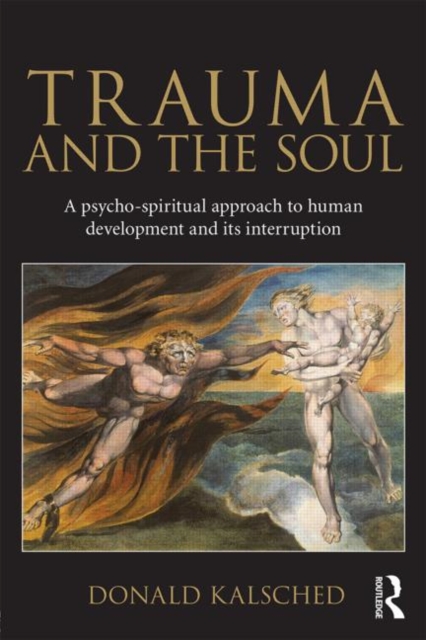
Kalsched takes that notion and expands on it, showing how that very system can often backfire in keeping a traumatized person away from connecting to the world and other people. In this way, what seems like a protection mechanism can easily turn into a personal hell riddled with demons and monsters, further pushing the individual away from real living and connections. As such, the Inner Protector becomes the Inner Persecutor, keeping its willing ‘victim’ away from real love, intimacy and the comfort of human connections, but also keeping the pain, mistrust, lies and betrayal which normally exist in human relationships, safely away from the wounded person.
The seductive dream world offers its inhabitant a uni-dimensional experience of life and it can be imagined as whispering: “I’ll keep you safe as long as you don’t connect to someone real and actually begin to live life again”. If the power dynamic is reversed, and through therapy the willing victim begins to recover and take control of their life, and healing is proceeding full-steam ahead, that’s when the self-care system can turn ‘evil’ and begin to trap the traumatized person into cycles of pain and self-sabotage.
No one but Kalsched warned me about the powerful ‘latch on’ effect that the so-called cozy dream world has on the psyche, and how what can begin as a powerfully protective and safe inner paradise can suddenly turn dark and foreboding at the slightest hint of recovery and freedom. In relation to this system that wants to keep you all for itself, this song by the National popped up in my mind as I was writing these words:
I liked how throughout the book, Kalsched contrasted his Jungian approach to trauma with Dante Alighieri’s “Inferno” (the first book in his Divine Comedy trilogy, and one which I randomly purchased when I was about 15 years old) and also with Antoine de Saint Exupery’s “The Little Prince”. I’m more of a fan of Dante’s than St Exupery’s work, because for whatever reason I just couldn’t resonate as a child with the story of a prince on the moon taking care of his rose…it felt embarrassing to my little girl’s mind, and it still does to this day. Nonetheless, Kalsched links the Devil in the final circle of Hell, described by Dante as Dis (the roman God of the underworld, also known as Pluto) with the mechanism that lies of the root of all trauma and that is dissociation. To bring things into perspective he also sees the little prince as a symbol of the lost innocence of a person’s soul which happens as a consequence of trauma in the process of dissociation.
Trauma and especially relationship trauma can “scare” the soul away from the body, and through strategies of staying somehow alive, such as dissociation, life continues on, but with the loss of the soul of the wounded individual. Traumatized people are “weird” because they no longer live in reality, they cannot bear the pain and suffering of relating as their soul escaped into a different world, one in which angels can become demons. He analyses this world by comparing it to Dante’s Inferno, and explores the Little Prince as an attempt of the human soul to regain its lost innocence before the trauma happened, to keep a vital spark that made life worth living.
For many traumatized people, the pain they experienced in reality becomes in their inner world, the image of an internal Persecutor/Protector, a jailer who offers them safety in exchange for a solitary existence. Initially, this system of self-care appears in the form of angels and protective ancestral influences, benevolent beings who keep a person alive and grants them some sort of meaning, solid enough to keep them living against the odds. But through repeated attempts to relate to others in reality and then being disappointed (and in some cases re-traumatized by others) a traumatized person’s system of self-care can gradually change shape and turn from an inner paradise into a living hell, populated with curses, monsters, punishments and pain. Sometimes this becomes the Devouring Anima for men & the Sadistic Animus for women, and often this is expressed on the outside, in the real world as acts of self-sabotage and mental health symptoms. The patient begins to wrestle with the angel.
Coming back to the larger perspective of Kalsched’s beautiful book I was really fascinated by the fact that he adopts a “psycho-spiritual approach”, which I am all about! Partly this may be the reason why I resonate so much with his writings. There is also an astrological reason why I am so drawn and uplifted by his work and that is because we are compatible signs, as I’m a Pisces Sun and Donald is a Capricorn Sun, so Water meets Earth in harmony, and on top of this his Sun touches upon my natal Neptune in Capricorn in the 3rd house. His work (the Sun) literally brings a spiritual approach (Neptune) to the working of my mind (3rd house).

I especially enjoyed his discussion of the two realms of existence: the real, material world and the spiritual, imaginary world in which people sometimes (and trauma survivors, often) escape into. Donald Kalsched believes a well-lived and healthy life is experienced in the middle part, on the bridge between these two worlds, where our bodies can become en-souled & feel alive enough to extract meaning from the spiritual and make things tangible in the practical. He offers the autobiography of Jung as an example of such a bridged life, where the analyst had to contain many times opposing forces within himself in order to expand his consciousness and reach “aha” moments of mental relief.
Kalsched underlines that only by accepting human suffering can the soul of the traumatized person come back to the body, and make it feel alive again. In this process, the role of the therapist (linked in the book to the image of the poet Virgil who accompanies Dante on his journey through hell, limbo and heaven) bears a great responsibility. A receptive therapist may be in certain circumstances the last good link to reality or stable anchor that a traumatized patient may have with the real world. A therapist begins to assist the patient in this struggle with the angel, to experience the beauty of the liminal space again and not to escape into the imaginary world, or remain strictly in material reality. As Kalsched clarifies:
“(…) it is a relationship that heals the trauma. But not just any relationship. The kind of relationship that makes a difference is the kind of transformative relationship actualized in the best contemporary psychotherapy (…). Such a relationship will have one eye open, looking outward and one eye closed, looking inward. Such a relationship will re-open both intersubjective & mytho-poetic space. It will “awaken the dreamer” in the patient. – p. 20,
And also:
there is a simple acceptance of the human condition, made possible by the previous long journey with a witnessing partner” – p. 125, Kalsched, 2013
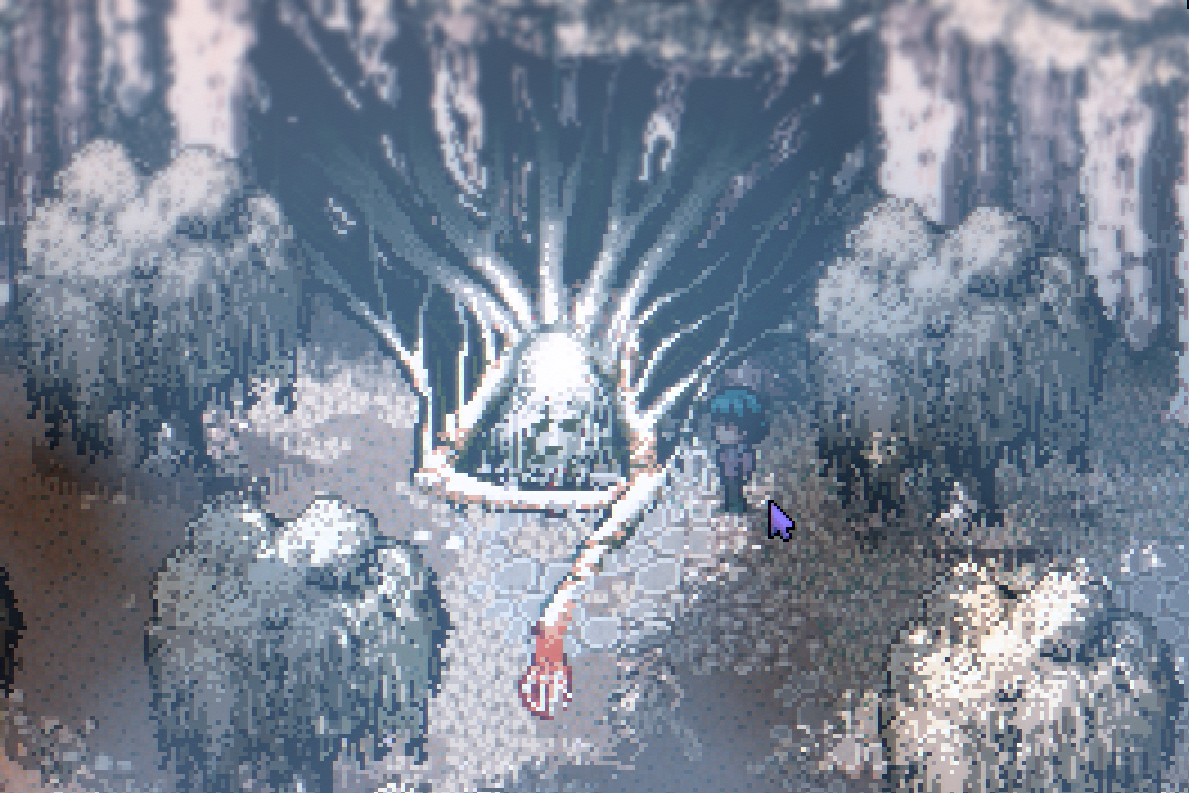
While I was reading Kalsched’s book in the evening, I was also playing games in the morning (I like to face the day with a strong cup of coffee and some minutes of gaming to wake up my brain). And lately I can’t get enough of the Eldritch-inspired horror farming game Welcome to Elderfield created by Chris Cote and released on Steam at the beginning of this month. In the game, among many horrible things that your character has to go through and fight, there is one that stood out to me, probably because it stimulated my unconscious concerns. There is a fallen angel that you come across at some point in the creepy Old Woods. This Angel resides in the Pale Clearing, a mystical, white, puffy place that sits in sharp contract to the jagged, rough, cumbersome decor of the rest of the frightening woods. Even the amazing soundtrack of the game disintegrates and loops ominously when you meet the fallen angel. You talk to the creature and it tells you that it once had a soul (it felt alive) but due to having fallen (the traumatic event) it remained isolated (hasn’t seen a living soul in ages) and is now hungry (blocked psychic energy that needs to be expressed).
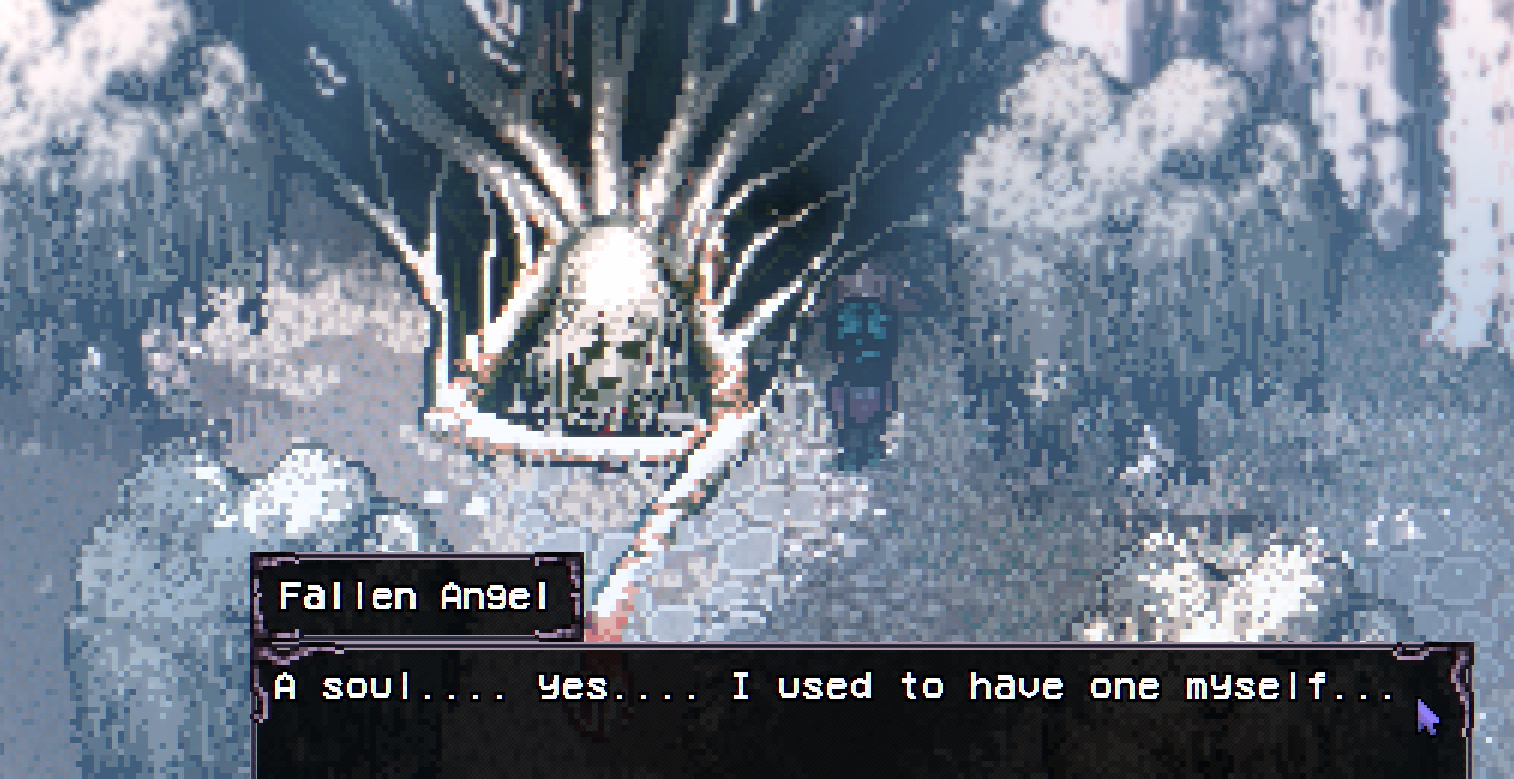
The Angel is ravenous and the only thing that may satiate its hunger is a living soul, either yours or the unfortunate one you may trap in one of your adventures. So, I caught such a living soul as a loot drop after I destroyed a Chest Mimic, and offered it to the angel to see what happens. Will my offer redeem the fallen creature? Well no, I was naive. The Angel devoured the soul in nano-seconds, accompanied by a very graphic description of the act. But then again, I am playing a horror game, so shit like this was naturally going to happen. What was I thinking? 🙂
In the Bible, we are told that fallen angels are demons even if they present themselves by their names before the fall, they become as such mirages of evil. However, Tammy Montgomery in her book “The Angel in Annunciation and Synchronicity:Knowledge and Belief in Carl Jung” believes that the dark, fallen or somber angel can have curative properties at the same time as it delivers scary messages, as she explains:
The presence of the somber angel, then, does not signify the presence of evil. Instead, it signals the conveyance of sobering information or insight into what once lay hidden (…) the process by which these dark contents come to light is often dreadful, painful, and inescapable. – p, 103, Montgomery, 2013
So, the fallen angel can be seen as an aspect of the Shadow energy at work in my life, and this is what this moment in the game left such a strong impression on me. And hoards of fallen angels or a general interest in demons and demonology could be indicative of the Shadow aspect of our collective unconscious, asking for some sort of light and interpretative redemption, like the ‘fallen angels’ in our celebrity worship.
Reading Kalsched’s text in parallel with playing this game jumpstarted my brain and something became illuminated. Trying to understand how the self-care system ‘s personal protection mechanism of keeping a victim trapped inside of themselves in a world filled with so-called angels, helped me see how emotionally attached I too had been in the past with this sugary, stereotypical understanding of divinity as purely “love and light”. In reality, the true presence of God exists in every rushed decision, act of self-sabotage or hellish day. As the zen master Thich Nhat Hanh said at some point ‘no mud, no lotus’. So beware the presence of paradise for it could contain more evil than obvious evil could actually engender.
This is why I believe women are so drawn in our current landscape to romance-fantasy books in which they make love to monsters. Because a monster can show you who he really is from the beginning, while an evil prince charming first has to deceive you and then destroy you. And it is the deception that amplifies the trauma. But more on this in another post…
I’m told by a quick Google search that the phrase “the better angels of our nature” was coined by Abraham Lincoln desperately trying to avoid a civil war and it was a call to solidarity and compassion during a period of division (The Dis in Dante’s Hell running amok in the nascent American collective unconscious). For Jung the main problem of the 20th century was the problem of the human soul, and the continuous pressure it has to withstand to remain whole and not be broken into two sides: the deeply materialistic one or the completely spiritual one. He believed mental health lies in the liminal space between the two, on the psychic bridge which would lead a person to moments of tension followed by moments of growth and then consciousness expansion.
Jung had Saturn in Aquarius and because he was a visionary he could pre-empt the movements of the psyche under the guidance of the planet Uranus, the very same movements which are transforming society during this decade and the next under Pluto’s transit through innovative Aquarius.
I was struck after finishing Kalsched’s book on the story of how the soul can be lost due to trauma by sinking into the depths of a profound depression or it can be invaded by anxiety, two very common mental health concerns during a time in which we have collectively lost our faith in a Higher Power. I don’t think there’s a coincidence that as God is no longer worshipped, individual psychic content is emerging as sheer madness out on the streets and on social media. My teacher, Mihaela Minulescu discusses how the human psyche has a symbolising function and a dia-bolising function: the first one helps brings thing into union, into a cohesive whole, while the latter severs, cuts, separates. It is the psychic equivalent of “the devil” within us all. The one who comes out when we choose to struggle with the angel, as we lose hope in life, ourselves and other people.
But the unconscious is always concerned with our adaptation to the social world around us and it will continue to send us dreams, moods, symptoms, synchronicities and will pull us into people who can help us in our healing journey. The important thing is that we stay open to it all, so that life can work through us rather than leave us. Communicating and checking in with one’s soul is as vital as brushing teeth, and can be part of the everyday hygiene of life. By having this constant inner dialogue with our spiritual nature then maybe we can bring some magic into our surrounding reality or at least enjoy and notice the magic that already exists in plain sight.
With universal love,
Lexi