Tag: books

  • The Ex : The Unconscious and Dangerous Growth

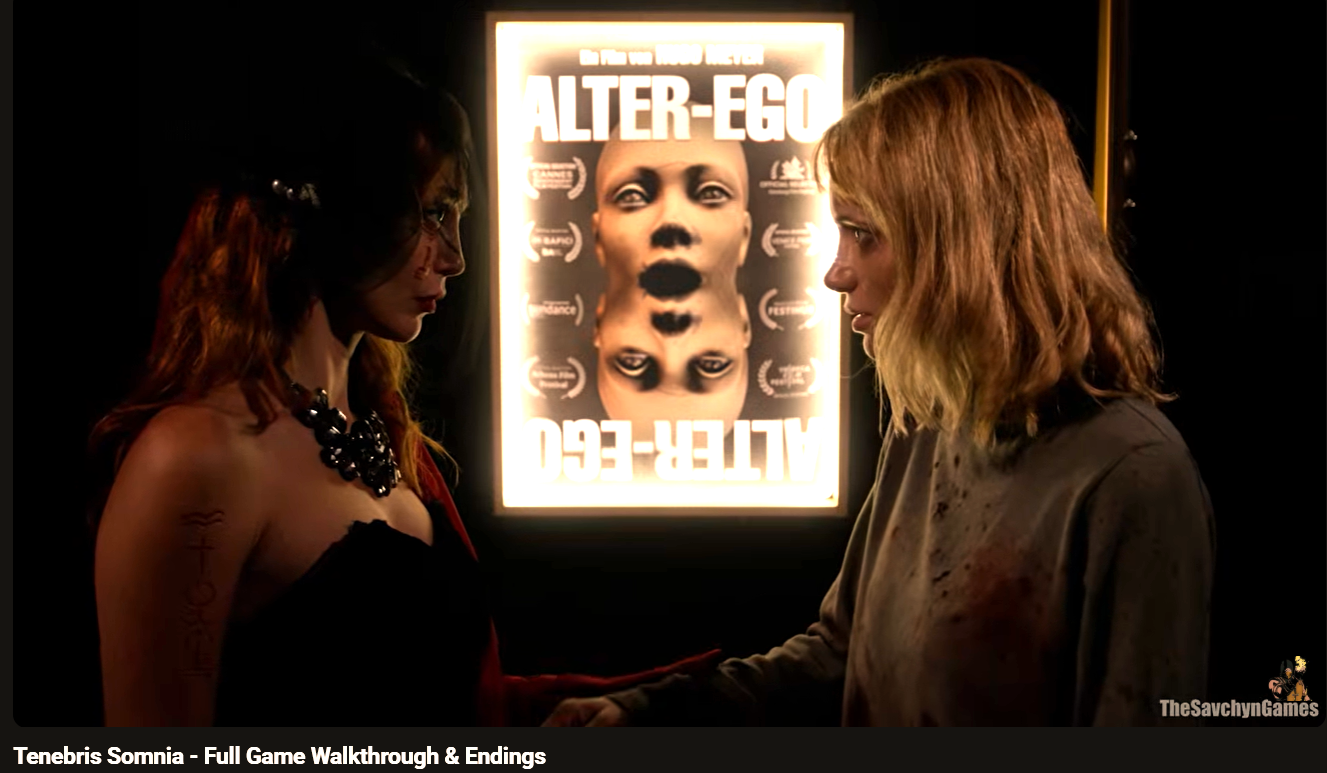
    Still from the game Tenebris Somnia created by Cancer Sun Andres Borghi, in which Julia faces for the final time her antagonist, the witchy Vitria

    I’m gradually waking up from being under the spell of two games in the last weeks, and these are the newly released Tenebris Somnia and Silver Pines. I don’t have the guts to play them myself but I watched the full gameplays on channels like TheSavchyngames and CJUGames on Youtube and I highly recommend that you give them a try. Instead of falling asleep to a movie each night, I would make a cup of cocoa and watch one hour of each game until dreams eventually overtook me. I must admit I had some fascinating dreams after each game, which then transformed into paintings (but more about this in an upcoming post).

    Tenebris Somnia (or dark dreams in Latin) is described on Steam as a “retro survival horror adventure game with live action cutscenes created by an award-winning film crew from Argentina. Unveil the depths of a disturbing story by solving puzzles and fighting horrible creatures. …What if they aren’t just nightmares?“. I don’t know why, but the atmosphere of the game is reminiscent to me of the movies “The Headless Woman” and “Santa Sangre“, two weird gems of Argentine cinema that have been haunting me ever since I saw them.

    On the other hand, Silver Pines is reminiscent more of “Twin Peaks” and “Silent Hill 2” with their heavy, brooding atmospheres and detective-like dynamics. The game was created by a team of Nordic developers and is described on Steam as “a survival horror metroidvania set in small town America. Fight nightmarish terrors and solve puzzles, while carefully managing your scarce resources as you uncover the mysteries that could hold the key to redemption.” Silver Pines has been nominated for best horror game of the year, although 2026 is a tough year for competitive horror games, seeing as we began the year with the masterpiece that is Resident Evil Requiem.

    The Pull of the Unconscious
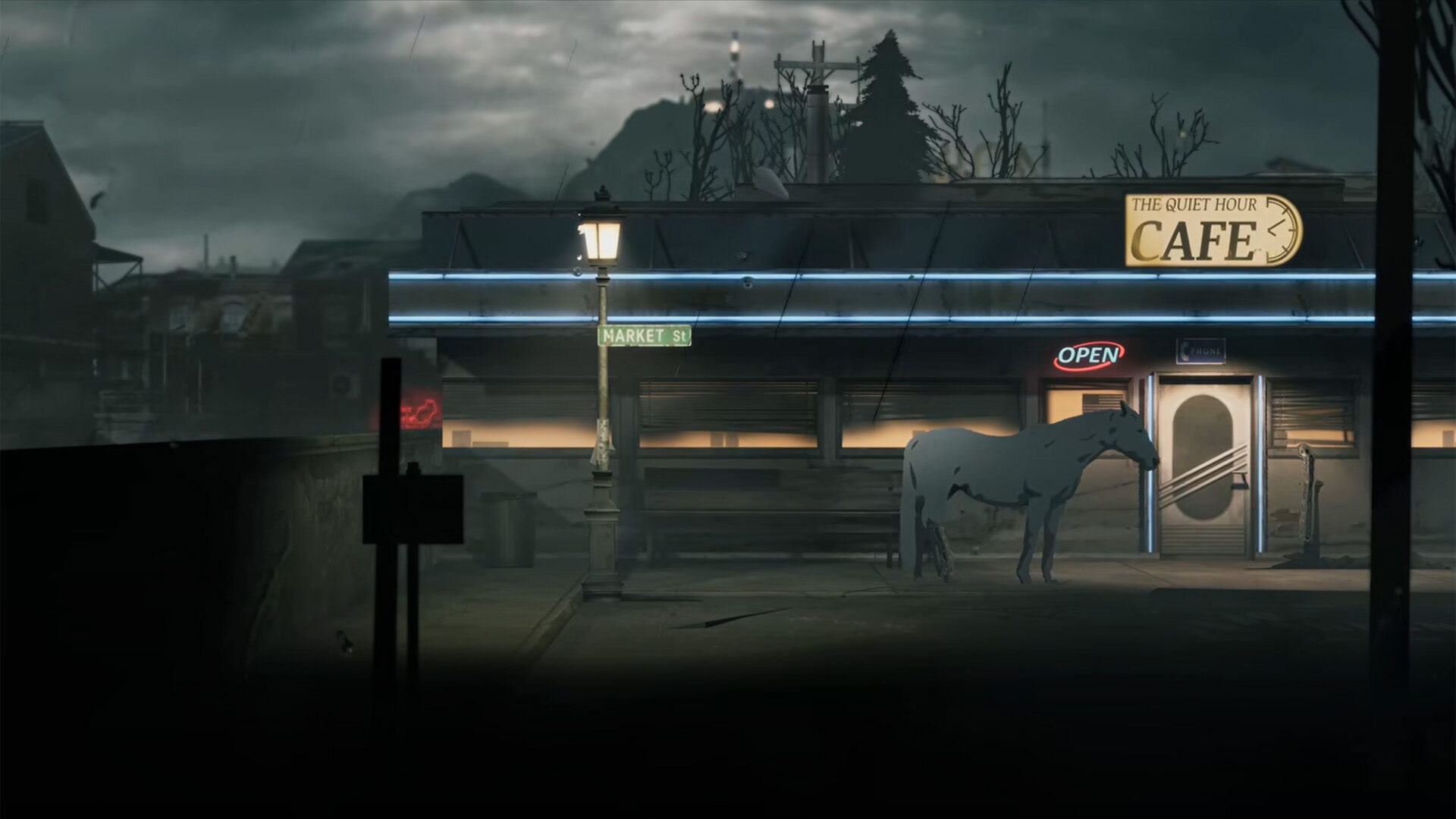
    Still from Silver Pines depicting the town’s Quiet Hour Cafe right before the storm and the wandering, emblectic white horse, as a symbol of death’s acceptance

    Both games have multiple endings and *spoiler alert* these are the aspects that I would like to unpack in this post which isn’t only about my sheer love for thoughtful horrors games but also about the psychological underpinnings of the protagonists’ stories, as they are revealted in their endings. And the endings revolve around an ex in one case and the past and the consequences of a man’s actions in another. These two themes are brought into foreground by the current and overlapping Mercury retrograde in Scorpio and Venus retrograde in Libra, helping collective energies to scavage through their romantic past.

    In Tenebris Somnia, Julia is persecuted by nightmares about her ex-boyfriend Ivan, and after failing to reach him she decides to use the apartment key she still was holding on to, in order to check up on him and see if he is alright. There are a number of red flags already at hand and I guess you can tell that one of the endings will involve Julia just looking at the key and deciding not to use it and not to check on her ex (which is exactly what I would’ve done, to be completely honest). I keep saying this to my clients that “an ex is an ex for a very good reason” but what would be the fun in listening to reason in a horror game, right?

    At the beginning of Tenebris Somnia, we are thrown into this kind of funny and slapstick, retro vintage gaming world, until the first real-action cut scene introduces us to a zombie-like creature who lunges at Julia with a forked tongue, and we are snapped into the brutal reality of the story. Julia seems eerily entranced throughout the game. She needs to find Ivan and find out what happened to him but she doesn’t know why she is doing this.

    In a similar vein, the detective of Silver Pines, Red Walker, has been hired by a mysterious man to find a musician named Eddie Velvet and as we later find out, is tasked with murdering him. Red is desperately searching for Velvet through the horrors of an abandoned town, soon to be besieged by a storm, without understanding exactly why he feels the compulsion to find this man. Both Red and Julia are gripped by their unconscious which pulls them to confront their fears, presented in each game as terrifying and creative-looking monsters.

    In the later parts of the game it becomes increasingly evident that Eddie and Red are the same man (watch as they share a fear of dogs, for example) and that Silver Pines is a projection of Red’s fractured psyche in the wake of an accident he had suffered which led to the death of his girlfriend. Red’s mysterious employer is the voice of his Ego, who drenched in self-hatred wants to keep him repressed and split off from finding the truth and awknowledging his guilt, at having caused the death of an innocent woman.

    In my view both of these fascinating characters, Julia and Red are symbols of the human Ego struggling to understand the unconscious. Often in our lives, we feel compelled or obsessed with certain activities or certain people without fully comprehending why. These are usually pivotal moments when important content from the unconscious wants to make itself known to our conscious mind in order for deep healing, somatic release and psychological growth to take place.

    Although, it needs to be said that such a quest, when undertaken with a view to fight and destroy the unconscious rather than to seek to understand it, will lead to the actual death or gradual psychic destruction of the person involved.

    And we see this theme of being overcome by nigredo (the darkening) or a retreat into psychological repression and fear, in both Julia’ s case in her Magnum Opus ending (where she kills the Relicta and fights Ivan only to obliterate her Shadow at his command), but also in the ending in which Red Walker finds Eddie Velvet and shoots him in the back, thereby completing his mission and never fully understanding the story he had been immersed in. Killing in both of these games carries the symbolic meaning of splitting apart, because after all, the greatest suffering happens in life when we separate parts of ourself and deny our whole being a right to exist freely. Splitting also happens when trauma occurs, which I will unpack below.
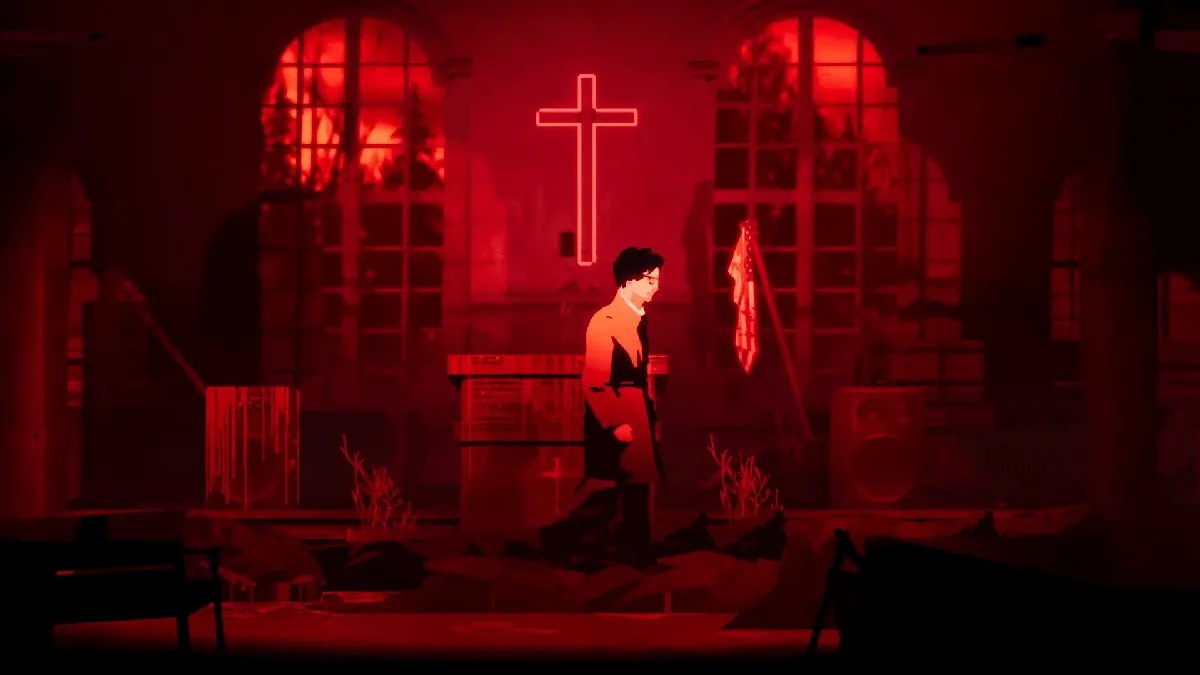
    Still of Red Walker in the town’s church right after a boss battle

    In these so-called ‘bad’ endings, Julia becomes afraid of the world and suspicious of every man as she retreats from her true Self and into the arms of her controlling and abusing ex-boyfriend, while Red continues to drive on endlessly into a night so dark that not even the moon can illuminate it. Both characters are doomed to remain in perpetual darkness, as nigredo extends indefinitely and cannot ascend to the clarity of the albedo stage or the warmth of the citrinitas/rubedo fulfillment, to use the alchemical words Jung has employed to describe the psychic development towards individuation.

    Haunting dreams seek our Attention

    Tenebris Somnia felt deeper and more meaningful as a story-line to me, because it dealt with domestic violence and I grew up with a controlling person who benefited from keeping me trapped and anxious. Therefore, I have intimate knowledge of how Julia must have felt in her relationship to Ivan, and empathized with her throughout the game. It was also fascinating to see that the so called ‘good ending of the game’ was titled ‘solve et coagula‘ (dissolve and coagulate), terms used by Carl Jung in his work on psychology and alchemy.

    In Tenebris Somnia, Julia’s journey can be seen as the process of solve et coagula which maps onto a woman’s quest for individuation through psychological transformation. In the bad ending (Magnum Opus), Julia slaughters her Relicta fragments with the Aurifer, a golden knife she creates through magic. Psychologically, killing is an act of violent psychic repression—she kills off parts of herself to survive, returning to reality permanently marked by her trauma (ex. the scar on her forehead remains but only in her mirrored reflection). In this version of her chosen reality, she remains bound to the archetype of her abuser, perpetuating the trauma cycle rather than escaping it.
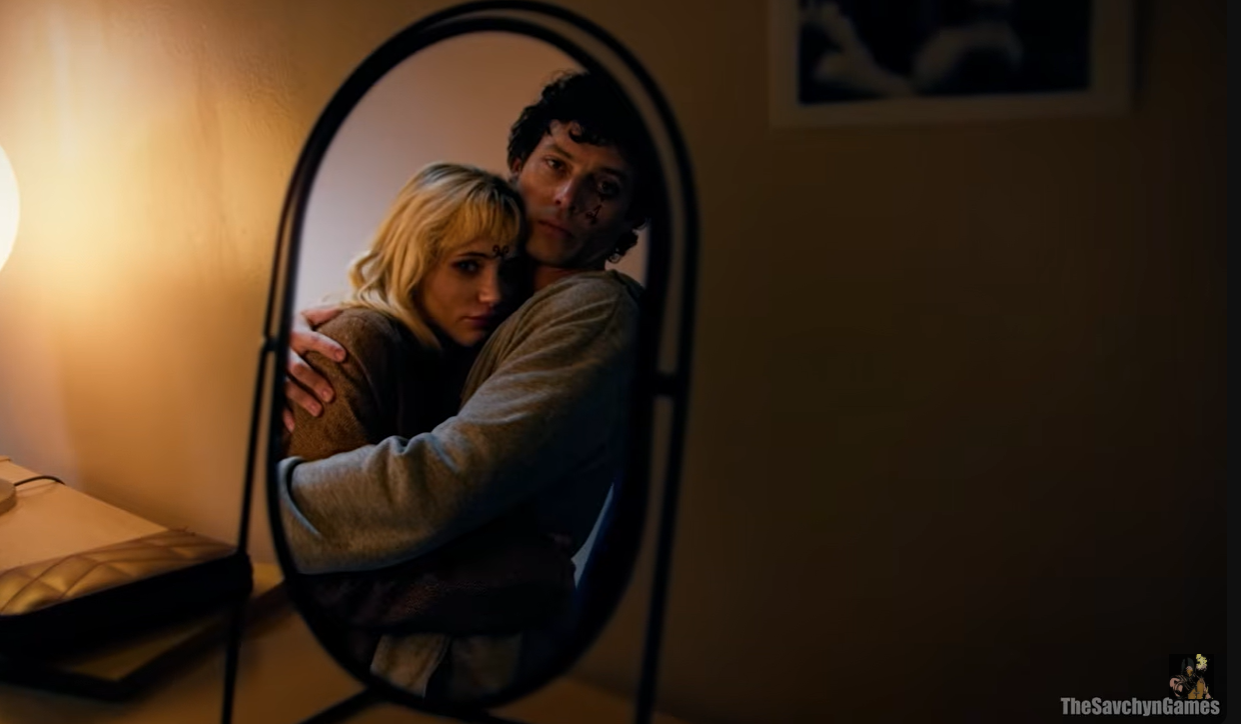
    Still of Julia and Ivan from the Magnum Opus ending of Tenebris Somnia

    On the other hand, by choosing the Solve et Coagula ending, she allows the old, victimized Ego structure to dissolve completely (solve). By refusing to attack her Shadow, she stops treating her internal trauma as an external enemy (she pulls her projection back). The final merging with the collapsing nightmare (coagula) is a raw, terrifying depiction of assimilating her Shadow. She doesn’t escape her history, rather she internalizes it to become whole, and I especially liked how tender she was with her Shadow when she met herself in the final boss battle, a sign that she has learned to be compassionate with the hurtful things she has chosen for herself in the past.

    In the epilogue, Julia channels a newfound raw and integrated psychic energy into her creative life as a filmmaker. She films a short-movie and debuts it at a premiere. Her film-making style is clearly different than that of her ex, Ivan, whose somber film-making contributed to her nightmarish psychic journey. In contrast, Julia’s work is funny, colourful and humane, and we see this through the way that the audience reacts to her film. I have to admit this final scene brought happy tears to my eyes, because I was so proud of her!

    In the Magnum opus ending, I was struck by how violent the relicta of Ivan was when she confronts him in the end and we see the true rage monster that was hiding inside the man she loved. The violence of Ivan’s relicta is a profound clinical depiction of what Jung called an autonomous complex bursting into consciousness with primal fury. Because Julia had suppressed the reality of Ivan’s abuse, that psychic energy didn’t vanish—it weaponized itself in her unconscious. When it finally manifested, it unleashed raw, unmitigated rage which she then problematically, turned against her Shadow rather than towards escaping Ivan and letting him go.

    We know by now that there are two halves of Julia’s reality, influenced by her decisions throughout the game, something that is aptly mirrored by the game’s shift between pixel art and live-action video. In the standard loop or the Magnum Opus ending, Julia’s psychic defenses are working against her: terrified of the outside world, her ego projects the internal threat (the danger of being harmed or controlled) onto innocent men in the public (like that guy in the subway).

    Because the trauma of Ivan’s abuse is unresolved, her psyche perceives the entire world as hostile. Paralyzed by this projected fear, she runs back to Ivan’s apartment. In trauma bonds, the abuser becomes the “safe harbor” from the very terror they created. Psychologically, Julia trades the unpredictable threat of the unknown world, for the predictable, familiar torment of her abuser. It is a regressive retreat to the root of her complex.

    In the empowered conclusion or the Solve et Coagula ending, her psychological orientation undergoes a deep change. The difference in her behavior is a textbook example of an integrated Shadow. True bravery in Jungian terms is not the elimination of fear, nor is it turning into the aggressor. In the bad ending, she attacks her fragments, becoming the abuser in order to survive.

    In the good ending, her refusal to harm her captors (symbolising aspects of her Self) shows that she has broken the cycle of victimization. She no longer needs to use violent defense mechanisms. By facing the monsters without attacking them, she looks at her trauma directly. And in turn, this robs the autonomous complexes of their stealth power over her psyche.

    Complexes or fears lose their terrifying grip on her because they are no longer hidden in the dark—they are acknowledged components of her history. By the end, she isn’t running back to the ruined apartment. She can exist in the live-action, objective world because she is no longer projecting her inner monsters onto random people around her. The outside world ceases to be a house of horrors the moment she cleanses her inner house.
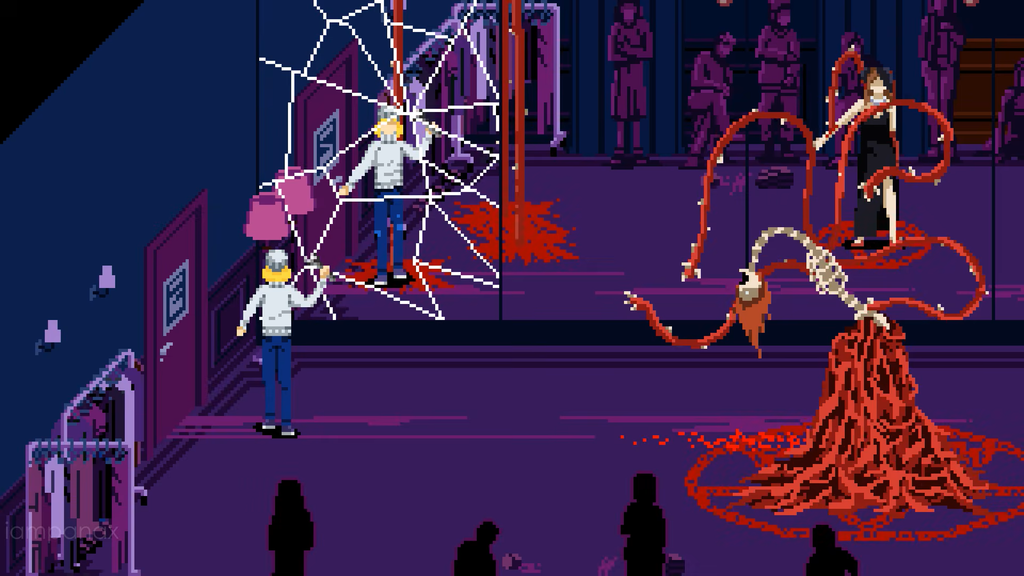
    Still of retro Julia battling Vitria through a mirror, a symbol of how she is desperately trying to integrate aspects of her Shadow but faces immense resistance from her Ego

    I liked how vulnerable she was being depicted during the premiere of her short film. We could see and feel her anxiety and her compulsion to project this anxiety on the public, like she would’ve done in the past, when her anxieties held her back and pushed her into a connection with a dominant and controlling man (Ivan). But she took a deep breath and held the tension and then suddenly the situation changed. The crowd started laughing because of the funny actor in her short film. All her worries of being perceived in a negative way or criticised by others were dispelled when her creative work touched the public.

    There was an immediate collective release of tension which was mirroring her own personal breakthrough: instead of falling into a past pattern, Julia stood her ground just by breathing, she held her anxiety and was brave enough to show up at her premiere and just see what happen. It shows that in time, through such repeated experiences, she will become a very strong woman, capable of controlling her own life (like a director) instead of projecting her control onto a domineering lover who may abuse her. This was the exact moment of Jung’s transcendent function manifesting in waking life, rather than just in her dreams or the pixelated unconscious of the game.

    What Julia is experiencing during the premiere of her short film is the shift from an unconscious compulsion to repeat the trauma loop to the conscious endurance of the “crucible.” Sometimes, to truly heal we need to hold and stay strong among uncomfortable feelings. In Jungian analysis, growth rarely looks like the permanent erasure of anxiety, rather it is a change in our relationship to that anxiety. We don’t get rid of our feelings, we transform them.

    In alchemy, this is maintaining the heat of a vessel without letting it crack. She allows the anxiety to exist within her body without reacting to it or offloading it onto others.Because Julia holds her internal tension, she creates the psychological space for reality to surprise her. By enduring these moments, Julia transitions from a passive actor trapped in Ivan’s abusive, black-and-white film to the author and director of her own and colourful psychic reality. This is a process that takes time and repetition. Each time she stands her ground in the face of her anxiety without retreating into the arms of a controller, she strengthens the new Ego she is carefully building for herself. She transforms her vulnerability from a liability into the very wellspring of her creative sovereignty.
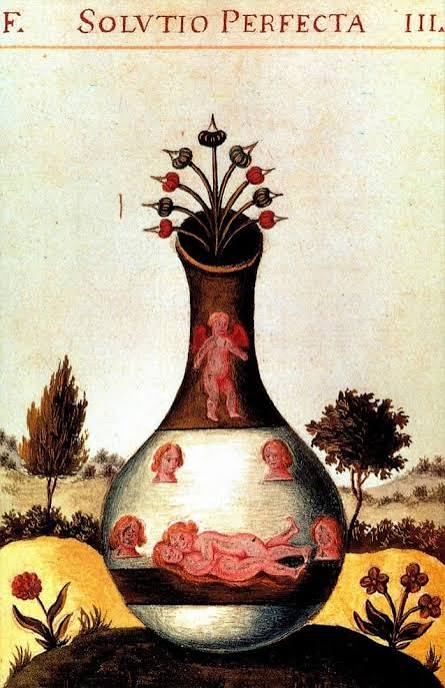
    Image depicting the alchemical vessel of containment, which can hold opposing forces (such as masculinity and femininity) with the purpose of transforming the soul

    Learning from THESE GAMES For Future ThErapeutic Work

    As a training analyst, I kept wondering what would I do in such a case, if a patient like Red Walker or Julia walks into my office? I was especially stuck at that scene of Julia’s premiere and marvelled at her subtle growth. I guess that when I would observe patients reaching this “premiere” stage in their own lives—where they face the terrifying choice between an old, toxic coping mechanism and a brave new path—I would think about what kind of clinical containment or support I could enact to help them hold that tension without collapsing back into the past.

    Since a patient has reached this advanced stage in their therapy, I don’t believe a maternal-like containment is necessary as this would be more appropriate for someone who is still possessed by a complex, but Julia emerged outside of it and may now need just some gentle nudging in the direction of courageous decisions. So I would offer her validating compliments based on her decisions to show up and hold the anxiety and I would continue to re-affirm the necessity of maintaing a strong connection to reality and to understand that she doesn’t have to be perfect, she just needs to be present and continue with the good work she is already doing.

    In my view, I would shift from the maternal, containing matrix (necessary for holding a fractured Ego together) to the paternal/transformative function of encouraging the ego to step out into the world with agency. After all, over-containing a patient at Julia’s stage can accidentally infantilize them or mirror the very dependency they are trying to escape. By offering validating compliments and focusing on presence over perfection,I can act as a steady witness to her emergent strength rather than a protector she must lean on.

    With universal love,

    Lexi

  • A Playlist to Surrender to a Dark Romance

    The Kiss by Antonio Ambrogio Alciati (1878-1929) – Pastel on paper

    As Mars enters Taurus and begins its return in my house of love and Other people (the 7th astrological house), I still feel under the spell of one of the most beautiful academic books I’ve read this year. It’s called “On the Way to the Wedding: Transforming the Love Relationship” by Linda Schierse-Leonard, a book initially published in 1987, which is as old as I am and so gently powerful.

    This book alongside with “The Inner World of Trauma: Archetypal Defenses of the Personal Spirit” by Donald Kalsched have to be the most amazing texts on love, relationships, healing and Jungian Analysis that I had the pleasure to discover this year.

    These books do something to you…something begins to move in your mind once you’ve finished reading them and dreams begin to proliferate. A wall in your heart begins to chip, as you start to see things around you differently. Even if you are the most sarcastic person on the planet, you begin to yearn for love. But if you are wounded in love, you may fall for someone who risks re-traumatizing you.

    Part of the fun of reading Linda’s book is that she titles the chapters of her book as “Prince Charming and the Special Princess”, “The Bewitchment” or “The Divine Wedding”, and my favourite “The Demon Lover”, as she breaks down fairy-tales and applies them to real cases from her patients and their mental health struggles.

    There’s magic in the struggle.

    Quote from page 77 in Linda’s book “On the Way to the Wedding”

    Inspired by this book and the seductively dangerous image of the Demon lover, I created a playlist, to engage in a fun and sexy way with this Archetype. I guess this playlist can also see you through a bad romance or two, until your self-love kicks in and you begin to feel worthy of better:

    The Cure – The Last Day of Summer


    Twilight Sad – It never was the same again

    Glass Animals – Black Mambo


    Idles – Beachland Ballroom (p.2)


    Daughter – Flaws

    Warpaint – Love is to die


    Bjork – Hidden Place


    James Blake – To the last


    Sweatcult – Pray

    Austra – Beyond a Mortal


    Smashing Pumpkins – Ava Adore HQ


    Jonathan Bree – Until We’re Done


    Ghostpoet – Sorry My Love, It’s You Not Me


    Cigarettes After Sex – Twizzler


    Editors – Two Hearted Spider

    Sea Power – Want to be free

    I initially created this playlist so I can listen to it while I’m preparing to read “Carmilla” by Sheridan Le Fanu, considered by many to be the first novel on vampires that started the trend. So I thought I’d share it. Hope this emotional sound-landscape adds a darker and interesting sheen to your life, whethever you may find yourself in the world.

    With universal love,

    Lexi

  • Kindred Spirits

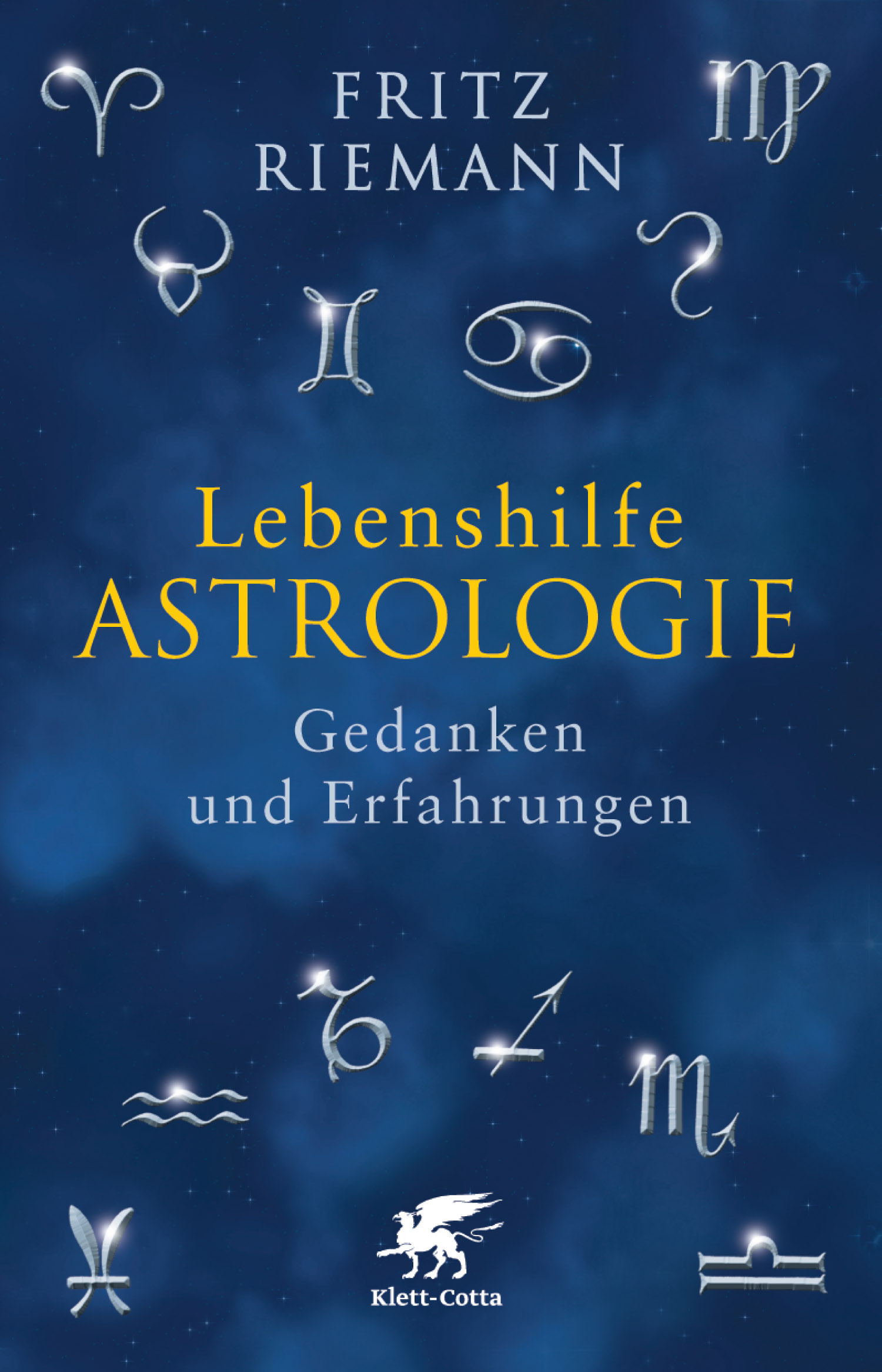
    I think I have found my spiritual father. His name is Fritz Riemann and I’ve been reading his work in the past week, at my analyst’s recommendation. I began first with his book which in English has been rather poorly translated as “Anxiety: Using Depth Psychology to Find a Balance in Your Life” (in its original: “Grundformen der Angst“), and then I realised that he was also the author of another book I had on my list, the beautifully titled “Astrology and Psychotherapy” (or “Lebenshilfe Astrologie“) a book which I see as the manual to my future profession.

    German cover to Fritz Riemann’s book “Astrology and Psychotherapy”, which you can access here: https://www.klett-cotta.de/produkt/fritz-riemann-lebenshilfe-astrologie-9783608946574-t-4101

    I’m just two weeks away from turning 39 years old, an age which is usually marked by something called the mid-life crisis. This is described as a pivotal period in a person’s life (usually spanning from the 37th year of life until the 41st) in which the foundations in a person’s life are revised and new decisions for the future have to be made. It’s like a pitstop in the middle of a person’s life in which past actions are coming up for scrutiny in order to find the answer to the burning question “How do I move forward in life?”.

    It’s called a “crisis” because something breaks down (usually a career path or a significant relationship, a way of life) and this catapults the individual into a pressure chamber of a mindspace, in which solutions need to be found with urgency.

    Carl Jung wrote about this period in a positive light. He saw this breakdown as a special indication that a person was getting closer to living out the truth of their identity or in his terms, the crisis was an opportunity to finally ‘individuate’. What made the crisis so intense was the extent to which someone had lied to themselves so far in their lives, and build a life on shaky and borrowed values, rather than on their personal intuition or on what mattered most to their individuality. In his words:

    The nearer we approach to the middle of life, and the better we have succeeded in entrenching ourselves in our personal attitudes and social positions, the more it appears as if we had discovered the right course and the right ideals and principles of behaviour. For this reason, we suppose them to be eternally valid, and make a virtue of unchangeably clinging to them. We overlook the essential fact that the social goal is attained only at the cost of a diminution of personality. Many—far too many aspects of life which should also have been experienced lie in the lumber-room among dusty memories; but sometimes, too, they are glowing coals under grey ashes. – C. Jung, The Collected Works, p. 395

    Astrologers also wrote about this period as being one marked by the multiple aspects that transiting Saturn would be making to the natal Saturn and Uranus placements in an individual’s chart, precipitating painful and unexpected changes that have long-lasting consequences. The most notable of which is Erin Sullivan in her book “The Astrology of Midlife and Aging”. Sullivan describes the mid-life crisis as:

    “Between the ages of thirty-seven and forty-one, in synchrony with the transit of the planet Uranus’ opposition to its place in the horoscope, something mysterious takes place within the psyche. Further, Dante says: “I cannot clearly say how I had entered the wood; I was so full of sleep just at the point where I abandoned the true path” (II 10-13) The ‘sleep’ with which we are full at the meeting at the crossroads is really the unconscious life that we have within and that is still unlived. Jung said that in this phase of life one is living the “unlived life”, assuming correctly that midlife does not begin a time of rapid decay, loss of libido, and inevitable death but rather in a time in which one might recollect one’s life and, from that recollection, build upon a profound understanding and conscious action toward the next phase of adulthood.” Sullivan, The Astrology of Midlife and Aging, p. 4

    Similarly to what Jung and Sullivan have described in their books, I also find myself needing to change my profession at this turning point in my life, as I am no longer able to make a living out of just being an astrologer and tarot reader. I am lucky that I am able to have the interior and exterior resources to be able to undergo this transition with a relative amount of meaning. After I was hit with the transit of Saturn conjunct my natal Mercury and Sun in the last 3 years, I witnessed the gradual loss of a lot of the things and people which used to anchor me in place. I’ve also felt blocked in my development, both creatively and emotionally and frustrated with life.

    This produced a crisis of meaning inside of myself and aware that Saturn rules over time and old age, I sought the wisdom of those older than me. In a random way – and possibly influenced by this year’s transit of nostalgic Jupiter in Cancer – I was reminded of an old dream of mine, that of completing my psychotherapeutic training. So after my father’s death I signed up for a professional training to become a Jungian analyst. And I’m happy to say that as lost as I was a couple of years ago, I am now meaningfully placed exactly where I need to be, since my current training offers me a sense of purpose and meaning, which I was robbed off in the past.

    However, there are still plenty of difficulties to overcome, most of which have to do with the reshaping of my very soul. I am overwhelmed at the moment by moods, fears and bouts of low energy, which I am processing each week with the help of my supervising analyst, by doing dream analysis and art therapy. This is where depth psychology and the work of many Jungian analysts come in handy, as I don’t believe I would’ve been able to start the process of “mining” through my memories and rearranging my inside, without their help.

    So here I am, in my second semester of professional training reading the works of Fritz Riemann and Marion Woodman, my substitute spiritual mother and father. While the German author is helping me stitch together my previous experience as an astrologer and put it in relation to my current experience of being a trainee psychotherapist, Marion Woodman is my wise maternal guide, helping me understand the deeper layers of my psyche and especially my relation to my own Shadow, and what lies beneath it: the Animus and the Death Mother Archetype, two figures who have been haunting me for a while.

    After, watching the documentary “The Way of the Dream” and having read her interview with Daniella Sieff titled “Confronting the Death Mother: An Interview with Marion Woodman“, I was curious to find out more about Marion, much like I wanted to discover more about Fritz and his attraction to astrology. I kind of feel like they are kindred spirits to me, or at least ancient members of my soul family. So naturally I pulled up their birth-charts.

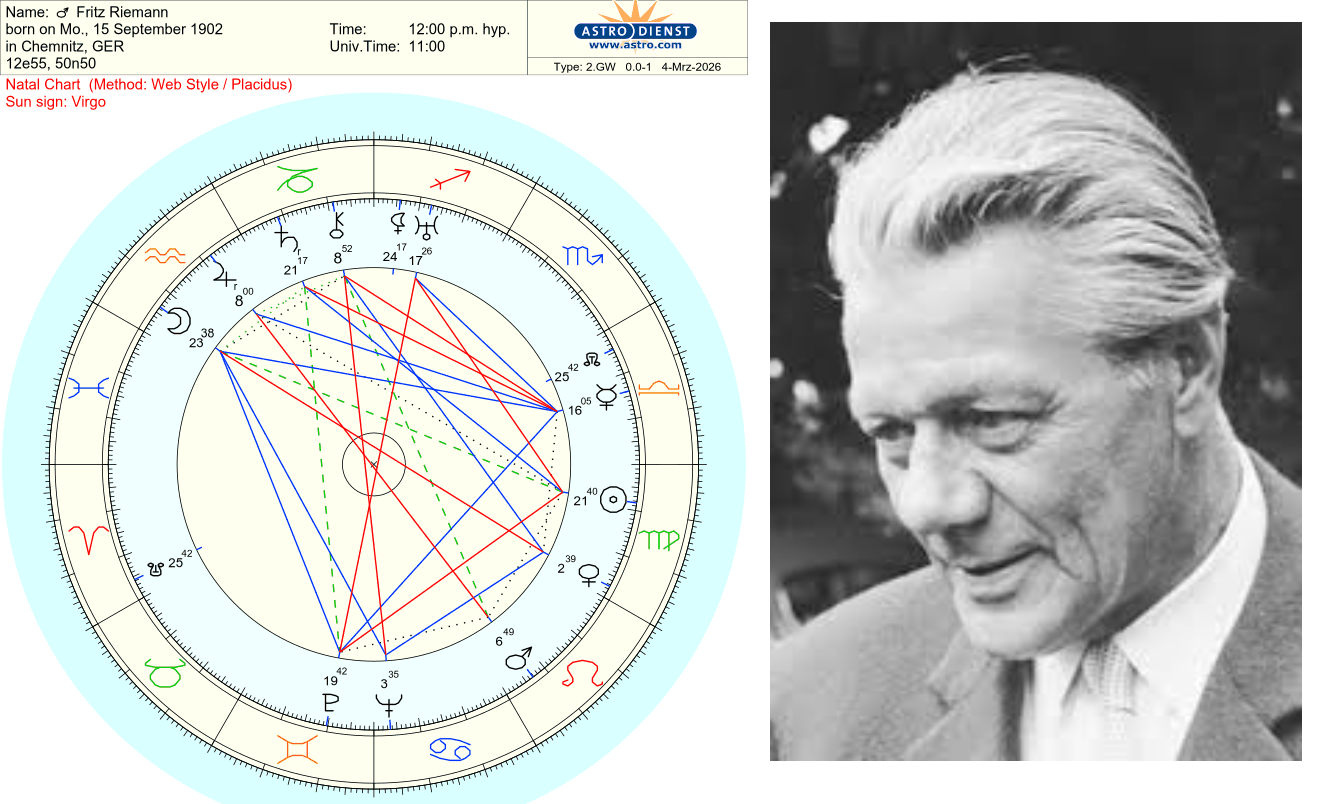
    Birth-chart of German author and psychotherapist, Fritz Riemann. Created with https://www.astro.com/index_e.htm

    Fritz was born a Sun in Virgo (loosely conjunct Venus), with a Moon in Aquarius (loosely conjunct Jupiter). He has a natal Saturn in Capricorn conjunct Chiron (the Wounded Healer Archetype) and a Uranus in Sagittarius conjunct Lilith (the Wild Feminine Archetype). Remarkably he is a member of the Pluto in Gemini generation and he has a natal Neptune in fellow water sign, Cancer. His Mars is in proud Leo and his Mercury is conjunct his North Node, both in the sign of Libra.

    His comfort zone, is marked by Aries, as his South Node is in Aries. Unfortunately, I have no idea in which astrological houses these planets are falling because I am lacking information on his birth time, and hence there is no Ascendant. But he seemed like a charismatic and optimistic fellow (which is rare for Virgo men to be honest). So I am wondering if perhaps his Ascendant was in Leo, which would’ve placed his Mars conjunct it too?

    In terms of comparing our charts and finding out why I feel he is one of my kindred spirits, I can see that he has his nodal placement opposite to mine as I was born with a SN in Libra/NN in Aries, and that his Moon and Jupiter fall around my Venus in Aquarius (so I fall in love with the ideas that he cared about, and with Aquarius energy these ideas are indeed audacious and astrological).

    Moreover, his Uranus in Sagittarius is conjunct my natal Saturn in the same sign (which makes him the perfect, wacky mentor for me) and his Pluto in Gemini sits in a tight conjunction to my natal Chiron in Gemini in the 8th house, while his Mars in Leo sits on top of my Midheaven. I interpret these two final aspects as being motivating and healing to me, even from beyond his grave. No wonder, I see his work as that of my spiritual father figure.

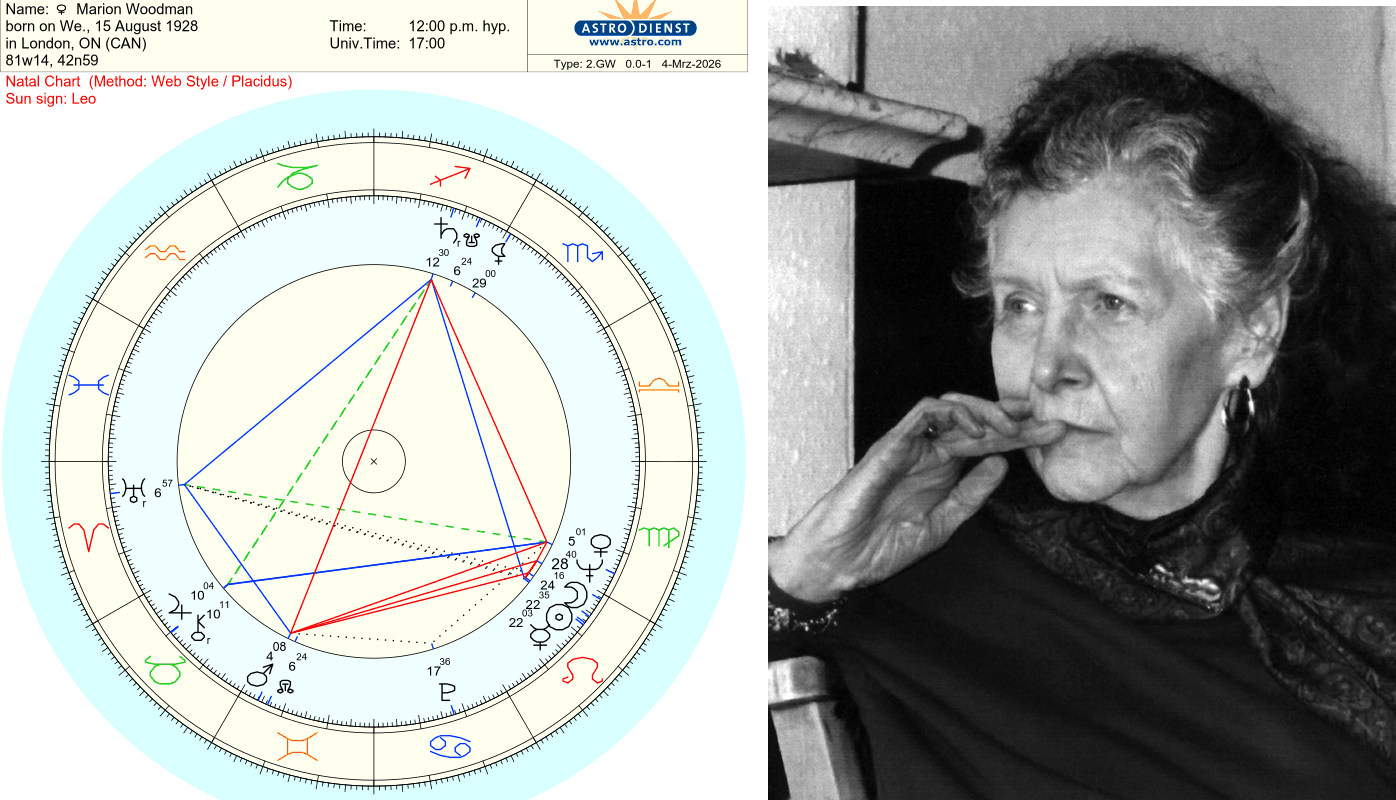
    Birth-chart of Canadian author and analyst, Marion Woodman. Created with https://www.astro.com/index_e.htm

    Moving on to Marion, she was born with a Sun in Leo conjunct the Moon and Mercury (so she is a New Moon baby, an aspect that denotes a pioneering spirit and a true individualist). She has her natal Venus conjunct Neptune in Virgo, an aspect which made her perfect for analytical work but it may have gradually eaten down her relationships due to a perfectionist streak. Furthermore, her natal Mars is conjunct the North Node in Gemini and her South Node is in Sagittarius (and sadly) conjunct her Saturn, which denotes a rough upbringing no matter how positive the Jupiterian influence may be.

    In addition, I see a bold Uranus in Aries, Pluto in maternal Cancer and Jupiter in enterprising Taurus conjunct Chiron (the Wounded Healer Archetype). You can easily see that she has not had an easy life and that growth for her came during painful moments when she was wounded but she had to heal others (Jupiter conjunct Chiron). At the same time, she was able to increase her awareness of the pains of the human condition and bring truth in areas of life previously thought of as taboo, such as in her description of the Inner Tyrant. Her book “The Ravaged Bridegroom: Masculinity in Women” is a pearl in terms of helping me understand the painful underbelly of romantic attractions and why they usually fail and end up in heart-break.

    Being born with Saturn conjunct your comfort zone means that any comfort in early life is usually robbed off you as a form of karmic debt, and Marion has been vocal in her book “Leaving my father’s house: A Journey to conscious femininity” about the strained relationship she has had with her father who blocked her chances of being herself (Saturn in Sagittarius). But she was an exceptionally intelligent and wise woman, almost to the point of having an intelligence which stood against her in many ways, and may have self-sabotaged her chances of being happy in life.

    In terms of placing her chart in conversation with my own natal chart, the fist thing I noticed is how we share the same Saturn placement and how her South Node is almost perfectly conjunct my Moon in Sagittarius, denoting a deep and unconsciously fertile link between the wisdom she provides and my compulsive search for wisdom. In addition, her Uranus in Aries is conjunct my natal North Node and Jupiter in Aries, making her a truly wise, maternal guide for me to learn a lot from, especially in relation to my own masculinity and wounded Animus (Aries).

    Moreover, her Pluto in Cancer falls in my 9th house, where I have Lilith in Cancer (the Wild Feminine Archetype), an aspect which I fondly refer to as the Erin Brockovich effect in terms of using feminine power to combat the abuses of the patriarchy. Marion’s writings liberate me and give me the feeling that I can live life completely free of taboos and complexes as a powerful woman, surviving a changing world (much like Marion had lived her life).

    It’s strange how I just begun with an intuition that I should read the works of both Fritz and Marion, and then as I dived into their work and found how strongly it resonated with me, I fell under the suspicion that it may be more to our shared energies than meets the eye. Astrology then showed me in concrete ways, of what I initially just spun out of the thin air of a gut feeling, that I was correct. So I rest my case once more.

    Astrology is truly magical, and following your intuition and insights is almost like putting the whole energy of your natal chart in motion towards fated events. This is why it is so important to allow the inner compass to guide you in life, rather than fall for external opinions or follow the indications of others. Trust your gut, trust you path and walk in the direction of your soul tribe. Pursue interests and learn from those who came before you. I would even go so far as to say that this may be the pragmatic application of Jung’s core theme of individuation.

    May your journey be filled with suprising joy and boundless wisdom!

    With light,

    Lexi

  • The Dark Romance of Jupiter Meeting the North Node, Saturn, Neptune and Uranus

    Final scene of Nosferatu (2024) directed by Robert Eggers, taken from https://taliesinttlg.blogspot.com/2025/04/nosferatu-2024-review.html

    The final leg of this intense Mercury retrograde in Scorpio/Sagittarius reminds us that we are currently under a beautiful astrological configuration, brought about by the meeting of Jupiter in Cancer (at 24° 47′ degrees) together with Saturn (25° 15′), the North Node ( 24° 24′), Neptune in Pisces (29° 45′) and also Uranus in Taurus (29° 16′). These 4 massive planets of our solar system, together with the lunar nodal axis in Pisces/Virgo, are cozying up to each other within the span of 5 degrees and forming pleasant and harmonious trines and sextiles.

    With so much soothing Water and Earth energy in the sky, the air feels thick with generative emotions, creating a fertile, spiritual ground for romantic ideas. But because Earth and Water romantic energy is often tinged with serious and rather heavy feelings such as melancholy, yearning, loss, sadness, possessiveness, forgiveness, and low self-worth, it develops a rather gothic and dark sheen.

    Collectively speaking, it took us a while to get here after a year that began with considerable chaos and irritations (and I blame Jupiter in detriment in the sign of Gemini for that). At the beginning of this year, most of us felt lost, almost like we dissolved and had to let go of things and people we felt emotionally attached to. This loss created spaces in our hearts, in our minds and in our homes that are now being watered and replenished by the rich soil of new seeds, a life germinating with so much emotional potential. A life which awaits the simple spark of Saturn re-entering Aries in the month of February 2026 to light up. Until then, we have time to reflect on what exactly this year was, and I’m personally choosing to do so through the medium of film.

    Saturn & the Bleeding Father Wound

    I think it’s significant that from a cinematic viewpoint we began the year with big releases such as Nosferatu and are ending it with Frankenstein. The Zeitgeist denotes a growing fascination with horror in our collective, both in terms of movies, but also in the gaming world. Could it be that the realm of horror in art is helping us deal with our own crippling existential anxieties in a collapsing socio-political environment? We usually associate the Archetype of the Father with the spark of vitality, with the energy to overcome obstacles, to boldly face life’s challenges and to contribute to society. But as society and social norms are dissolving right before our eyes, is our conception of the protective and all-encompassing Father Figure also crumbling?

    Much like it was gorgeously shown in Guillermo del Toro’s Frankenstein, are we left with hunting the monsters of our own psyche, placing upon those on the fringes of society the monstrous qualities of our unintegrated, collective Shadow? Is this why it feels so difficult to exist as a non-conformist, sensitive and creative person in a global village in which everyone thinks the same, looks the same and feels nothing?

    Movie still of Mia Goth and Jacob Elordi in Guillermo del Toro’s “Frankenstein”. Taken from: https://www.cbr.com/netflixs-frankenstein-final-trailer/

    If masculinity then appears distorted in our collective unconscious do we transform it into something perverse or perhaps expect it to be perverse? Because things usually exist in pairs, then we cannot speak of a ‘perverse’ or ‘distorted’ form of masculinity haunting the collective without shedding light on its opposite: the higher-minder, redeeming image of man, as a defender, protector and spiritual guide. This is why we may have these counter-trends proliferating in the collective at the moment, being swept over by both religious fervour (see Rapture Tok) and smutty satisfaction (see Werewolf Romances or Biker Tok). There’s a lot more to say on this topic but I’ll let Jungian Analyst and prolific fairy-tale collector, Marie-Louise von Franz explain the psychological tendencies:

    People of all ages needed an inner guide to help them overcome life's trials. This need has prompted people to see in certain individuals, gods or deified inspired personalities, the personification of all the skills they are looking for. When people are confronted with this impulse, the father archetype often appears, bearing the image of a deified or god-like counselor.
    - p. 255, Archetypal Symbols in Fairy-Tales: The Profane and the Magical.

    So, at present, are we choosing (more or less consciously) to worship a Demonic Father, a Destructive God which imbued with our own unacknowledged heavy feelings, has the power to obliterate us? Are we then seeking redemption through destruction? And how do these collective energies in which we exist daily end up affecting our behaviours, especially our gendered attachments?

    Some Uranus in Taurus Witchcraft

    For me, 2025 started with a trip to the local movie house to see Nosferatu, a movie I was eagerly waiting for. Stuffed in my seat liked a tinned sardine with a big crowd in a room that was hellishly warm because the air conditioning was not at full capacity on that cold January evening, I was too distracted to enjoy the movie by the bickering couple sitting next to me who had also berated me for not sitting in my proper place (aka the one I bought the ticket for). Nonetheless, I loved the movie! The dark aesthetics lingered in my mind, as well as that unforgettable, final scene, symbolic of the painting Death and the Maiden (see first image of this post).

    After the movie, I came home and felt a sudden and overwhelming urge to take a bath. But rationally I told myself “No, don’t take a bath, because you are during your period at your day with the highest flow and you will literally bathe in your own blood if you do”.

    Stupidly enough, I listened to reason and learned to regret it, because I woke up the next day with a severe cold that locked me in bed for the next 3 days. After I recovered, and being an impressionable Pisces, I felt that somehow the dark and evil nature of the monster portrayed in Nosferatu was somehow “stuck” to me and made me feel physically ill. I did some occult research and discovered that bathing in your own blood is actually a protective strategy that can help someone let go of the slimy energetic strings that were attached to her through the malevolent evil eye of others (or in my case, the bad vibes of the bickering, dramatic couple sitting next to me in the cinema). Menstrual blood is especially powerful, as it contains both death and the seeds of life alongside with the protective energy of the discarded uterine lining.

    The entire experience was yet another lesson in learning how to trust and listen to my insights, visions and intuition. For a while after that, I was kind of afraid of re-watching Nosferatu because I associated the movie with getting ill and did not want to repeat the experience. Nonetheless, I decided to face my fear and saw the movie once again, at the end of August this time, projected onto the barren wall of my bedroom. Alone, in stillness, only disturbed by a cool breeze from the summer air wafting through my room, the slow sound of traffic and the crickets outside, I finally enjoyed the movie. I also did not catch a cold or argued with strangers and I saved my pocket money for candles and crystals.

    Just as a sidenote, having lived through a lot of things in life and travelled extensively, I generally recommend solitary experiences to collective ones. Solitude truly is a gift and we should learn to value it and appreciate it more. That being said, this post is about love 🙂

    Or better said, it is about romance and the way it blends with love at the level of our unconscious dark fantasies under this blissful astrological configuration covering the months of November and December of 2025.

    Jupiter, the Quirky Dark Romantic

    When two of the planetary giants of our solar systems (Saturn and Jupiter) find themselves shining through two of the most sensitive, soft and romantic Water signs, a deep rollercoaster of emotions is unleashed onto the collective. Socially, we find ourselves at the mercy of attachment triggers, insecurity hot-spots and conflicting emotions. Much of the anger we get to experience in the collective, has at its root a terrifying sadness and fear of abandonment.

    Despite, their romantic nature, sweetness and adaptability, Cancer and Pisces can be the bringers of great suffering and pain in their lives and the lives of those they come into contact with. This happens when instead of understanding, accepting and mastering their emotionality, they succumb to it or they repress it (by pushing what they feel deep in their unconscious), thereby fuelling their Shadow Selves. People who succumb to their Shadow and live governed by their unconscious desires, become that very thing that they fear: the monsters, those with a great capacity for harm and psychological damage.

    Cole Sprouse and Kathryn Newton in ‘Lisa Frankenstein.’ Michele K. Short, image taken from https://www.hollywoodreporter.com/movies/movie-reviews/lisa-frankenstein-review-kathryn-newton-cole-sprouse-diablo-cody-1235816547/

    Since Jupiterian matters are simultaneously light-hearted and yet filled with rich meaning, I need to say a couple of words here about the wonder-fest that Lisa Frankenstein is. I discovered this Diablo Cody creation this year and have already seen it thrice, I just love it so much! Flipping the script on the male-dominated plot of Frankenstein, this movie has a certain unique, camp charm combined with female ingenuity on the background of an 80s synth-wave trip. The plot revolves around strange Lisa who lives with her father, her step-mom and step-sister in a sleepy, suburban neighbourhood. Her life is marred by a gruesome event that traumatised her childhood and makes her rather reclusive. She takes her social awkwardness and fantasizes in a bachelor’s cemetery about her ideal boyfriend while dabbling in some light witchcraft.

    Then on a stormy day she accidentally brings to life a young noble-man who zombies his way to her house to profess undying love to her. He is disabled and smells awful but his heart seems in the right place. To make him human-looking again she has to come up with some creative ideas, and thank God she knows how to sew! Chaos ensues in the sweetest and most psychotic way possible, and I guarantee you will find it hard to guess the ending.

    The fascinating thing about Lisa Frankenstein is how her rage and overall teen angst is somehow projected onto the Creature, who ends up putting into action her murderous intent and sadistic fantasies, especially geared towards her borderline step-mother. By falling in love with her, the Creature somehow redeems Lisa of her lowest desires and darker feelings. Their weird, beyond-the-grave love has therefore, cathartic properties, reminding us (again, from a flipped gendered-perspective this time), that love has the power to quench rage and transform death into life again.

    This is a delightful movie, considering how low on romantic outputs the past few years have been in Hollywood. I also love the trend of 80s inspired dark romances and slashers. Inevitably, this movie sent me thinking of Totally Killer, a movie I added to this year’s Halloween list of recommended frights.

    Neptune or When you Love the Monster

    Judging by the rising popularity of creepy, dark romance content on Book Tok, I think it can be said that this year, under the wounded and distorted, paternal energy of the Saturn-Neptune conjunction and Chiron in the sign of Aries (which I wrote about in a previous post), we are all unconsciously processing our strained relationship to men and masculinity, and especially to our fathers, the first men we loved.

    Increasingly, it seems that the fine line between the sado-masochistic content of personal fantasies is pervading the collective, who find enjoyment and liberation in stirring up social discoussion around these darkly, ecstatic experiences. This is also driven by greed, a typical manifestation of Uranus in Taurus energy, because what is taboo, forbidden or mysterious usually sells really well.

    Nonetheless, I wonder what this form of dark consumption is doing to our psyches in the long-run? Like a Halloween Bacchanal taking place in the privacy of your home and on your phone’s lit up screen, a gallery of perversions and dehumanising acts are misinterpreted as sexy and romantic to rather cringe-worthy heights. Could this be a marker of our sexual appetites changing or of a collective call for desensitization brought about by the transit of emotionally detached and freaky Pluto in Aquarius?

    I’ll let you find your own answers to this one.

    Movie still of Tyler Galpin and Wednesday Addams from Wednesday Season 2. Taken from: https://www.sportskeeda.com/us/shows/he-s-f-king-evil-internet-divided-whether-wednesday-tyler-end-together-wednesday-season-2

    In all honesty, I’ve also been consuming this year a lot of analogue horror content and I began listening to heavy metal. With Jupiter’s transit into nostalgic Cancer, and at my therapist’s request, I started looking for ways to consume the pent-up rage I have been feeling towards my mother in the wake of my father’s death. Taking walks at night-time, drawing monsters and shadow figures, cursing people who harmed me and listening to heavy metal were such sublimation strategies to process my anger. And I admit that as time passes, these sublimation strategies are working and I felt lighter. My mind is also remembering the background to my teenage years, mired in the foreboding sound of bands like System of a Down, Korn and Slipknot. Paradoxically, hearing men scream feels like they are screaming for me, in my name, in the name of the soul inside of me grappling to catch light again.

    However, using creepy symbols, scary masks and war paint, dancing and shouting were also survival strategies our ancestors used when faced with the dark forces of disease and violence. Sometimes you become scary when you feel at your most vulnerable and are frightened yourself. As a protective strategy – you become that which you fear in an effort to push back on the energy crossing your boundaries and consuming your identity. This is where the fathomless creatures of Neptune, the God of the Sea, rear their ugly heads, in the realm of dreams and in the silent waters of our inner emotional reservoir. We sometimes reach down inside this fantasy realm to gather the strength to fight the beasts surrounding us, whether human or imaginary. And sometimes to overcome the darkness, we must become it, this being the behaviour encouraged by the camouflaging tendencies of Neptune, domicile in the sign of Pisces.

    Recently in the second season of Wednesday, we’ve seen the overt conflict between Tyler and Wednesday, as it is now revealed that he is indeed the Hyde and therefore highly dangerous. Tyler is locked away in an asylum, seething in his rage at being betrayed by the Addams family prodigy, he once felt so attracted to but also attempted to murder. Although both Tyler and Wednesday are exploring their difficult attachments to their mother figures in this season, the overall feeling I had while watching the narrative unfold is the terrible weight of loving somebody who is overwhelmed by their Shadow, to the point of having a monstrous alter-ego.

    From a paternal point of view, I also found it interesting that Tyler’s father is ashamed of his son, while Wednesday’s father is proud of her. Could this psychological resource determine the boldness that Wednesday shows in directly facing Tyler in Hyde form, the monster she loves? (it is to be assumed that love is involved, since Wednesday so obviously displays psychopathic tendencies which normally inhibit affect).

    Although Tyler is the one in visible chains, Wednesday is the one having to deal with the emotional repercussions of loving someone monstruous, someone who consistently helps her and also harms her. But this tendency exists inside of herself too. Underneath her amateur detective Persona, Wednesday harbours towards Tyler the simultaneous desire to help him while also fighting with him.

    In general, it seems that in the absence of meaningful myths to guide us we have been seduced to fall into the cesspool of dark fantasy images produced by contemporary culture and social media. It could be an act of creative absolution to reclaim myths and fairy-tales that align with our values and personal identities and use these as meaningful shields against collective dissolution, meaninglessness and cheap thrills. Maybe experiencing dark romances or exploring our Shadow aspects in love connections, could be the liberating way forward, where instead of pressuring each other into unsustainable, positive ever-afters, we process our pain and wounding into powerful and energy-giving, romantic transformations.

    With universal love,

    Lexi